




AWS environments rarely become insecure because one security feature is missing. Risk usually accumulates across excessive IAM permissions, unnecessary network exposure, configuration drift, incomplete logging, and security findings nobody owns.
More security tools do not automatically solve that problem. Strong AWS security requires an operating model that limits what identities can do, controls which resources can communicate, detects abnormal behavior, and turns findings into prioritized remediation.
This guide covers practical AWS security best practices for production environments, focusing on IAM, network security, threat detection, monitoring, and infrastructure hardening.
AWS provides security services across identity, network protection, data protection, detection, governance, and compliance. Challenge is deciding which controls matter for a specific environment.
Production account running several EC2 instances has a different attack surface from a multi-account platform operating EKS clusters, public APIs, managed databases, and hundreds of IAM roles.
Useful AWS security architecture starts with four questions:
Those questions create four practical security layers: Identity, Exposure, Detection, and Response.
This approach also makes security assessments more useful. Instead of producing hundreds of disconnected findings, teams can identify attack paths and prioritize controls that reduce the most risk.
OpsWorks' Security & Compliance services address this broader problem through cloud security assessment, compliance support, DevSecOps integration, security testing automation, secrets management, monitoring, and incident management.
Compromised credentials with excessive permissions can bypass many security controls without exploiting a traditional software vulnerability. Identity is therefore one of the highest-value areas for AWS security hardening.
Long-lived IAM users should not be the default access model for engineering teams.
Workforce access can use federation through an identity provider and AWS IAM Identity Center. Workloads should use IAM roles and temporary credentials whenever supported.
Temporary credentials reduce the lifetime of exposed credentials and simplify centralized access management.
Root credentials require stricter treatment. Root access should be protected with MFA, excluded from everyday administration, and monitored for unexpected use.
Least privilege is not a one-time IAM cleanup.
Permissions that were appropriate six months ago may become excessive after an application changes, a migration finishes, or a team moves.
IAM Access Analyzer can help identify unintended external access and refine permissions. Permissions boundaries can limit delegated administration, while Service Control Policies establish organization-level guardrails.
Broad Action and Resource permissions deserve attention, but wildcard detection alone is not enough. Real risk depends on what actions are available, which resources are reachable, and whether a compromised identity could escalate privileges or move between accounts.
Large AWS organizations should therefore separate organization-level guardrails from workload permissions. Platform teams define boundaries; application teams operate within them.
AWS network security is not simply about putting workloads into private subnets. Useful question is: Which systems need to communicate, through which paths, and under what conditions?
Public exposure should be intentional. Internal reachability should be intentional too. Review internet-facing load balancers, public IP assignments, broad security-group rules, public database endpoints, administrative ports, unrestricted outbound traffic, and service endpoints that do not need internet exposure.
Security groups provide workload-level stateful filtering. Network ACLs can enforce subnet-level controls. AWS Network Firewall adds centralized traffic inspection where required. AWS WAF protects HTTP applications, while AWS Shield addresses DDoS protection.
Private connectivity, VPC endpoints, Transit Gateway architectures, segmentation, and controlled routing can further reduce unnecessary exposure and lateral movement. No individual AWS network security service replaces architecture.
WAF cannot correct an inappropriate database network path. Network Firewall cannot repair excessive IAM permissions. Private subnets cannot protect an application from a compromised authorized identity.
Network controls therefore need to be evaluated together with identity, workload, and application security.
Network isolation loses value when credentials are embedded in application configuration or sensitive data remains broadly accessible.
Secrets Manager or Parameter Store can remove credentials from source code and static configuration, while KMS-based encryption provides control over encryption keys.
Access still matters. Encrypted data with an overly broad KMS policy can remain exposed to compromised workloads. Secret rotation without application support can create operational failures.
Security design therefore needs to consider access, lifecycle, ownership, and recovery together. Many of these controls should begin before deployment. OpsWorks' guide to DevSecOps implementation and CI/CD security covers secrets scanning, IaC scanning, container security, and policy checks within software delivery pipelines.
Preventive controls will never eliminate every attack path. Credentials can be compromised. Applications can contain vulnerabilities. Configuration can drift. Trusted identities can behave unexpectedly.
AWS threat detection should answer a different question:
How quickly can the organization identify behavior that should not be happening?
Different AWS services provide different parts of that visibility.
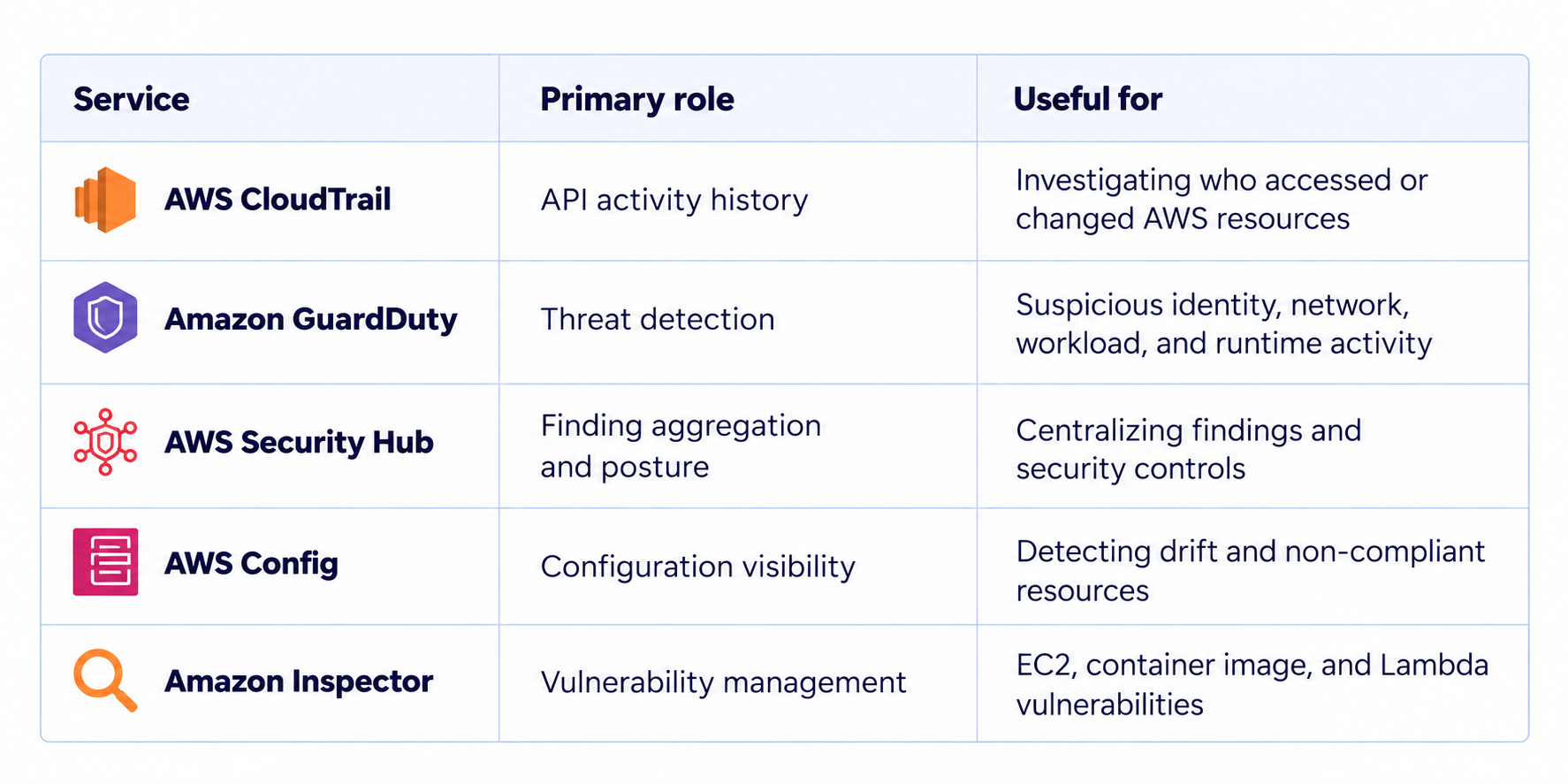
Strong AWS threat detection connects these signals rather than operating each service as a separate dashboard.
Security logs become most valuable during an incident, which is exactly when discovering incomplete coverage becomes expensive.
CloudTrail should provide reliable visibility into relevant AWS API activity. Network, DNS, load balancer, EKS audit, identity, and application logs can provide additional context depending on architecture.
Logs should be centralized where appropriate, protected from unauthorized modification, retained according to security and compliance requirements, and searchable during investigations. Collecting every possible event indefinitely is not the objective.
Logging strategy should identify which telemetry supports detection, investigation, compliance, and forensic requirements. Similar principles apply to production monitoring more broadly, as described in OpsWorks' Cloud Observability Strategy.
Amazon GuardDuty can identify suspicious AWS activity including credential misuse, unusual API behavior, malicious network activity, and selected workload or runtime threats.
Enabling it is only the first step. Finding without ownership is still an unresolved risk. Teams need defined rules for which findings require immediate response, additional investigation, automated ticket creation, or automated containment.
OpsWorks' AWS Infrastructure Security Hardening with Threat Detection offering addresses this operational layer through vulnerability assessment, Amazon GuardDuty, EKS Audit Log Monitoring, Runtime Monitoring, and continuous security monitoring.
Security Hub, GuardDuty, Inspector, Config, vulnerability scanners, Kubernetes security tools, and SIEM platforms can generate thousands of findings. More findings do not necessarily mean better security. Severity should be one input rather than the entire decision.
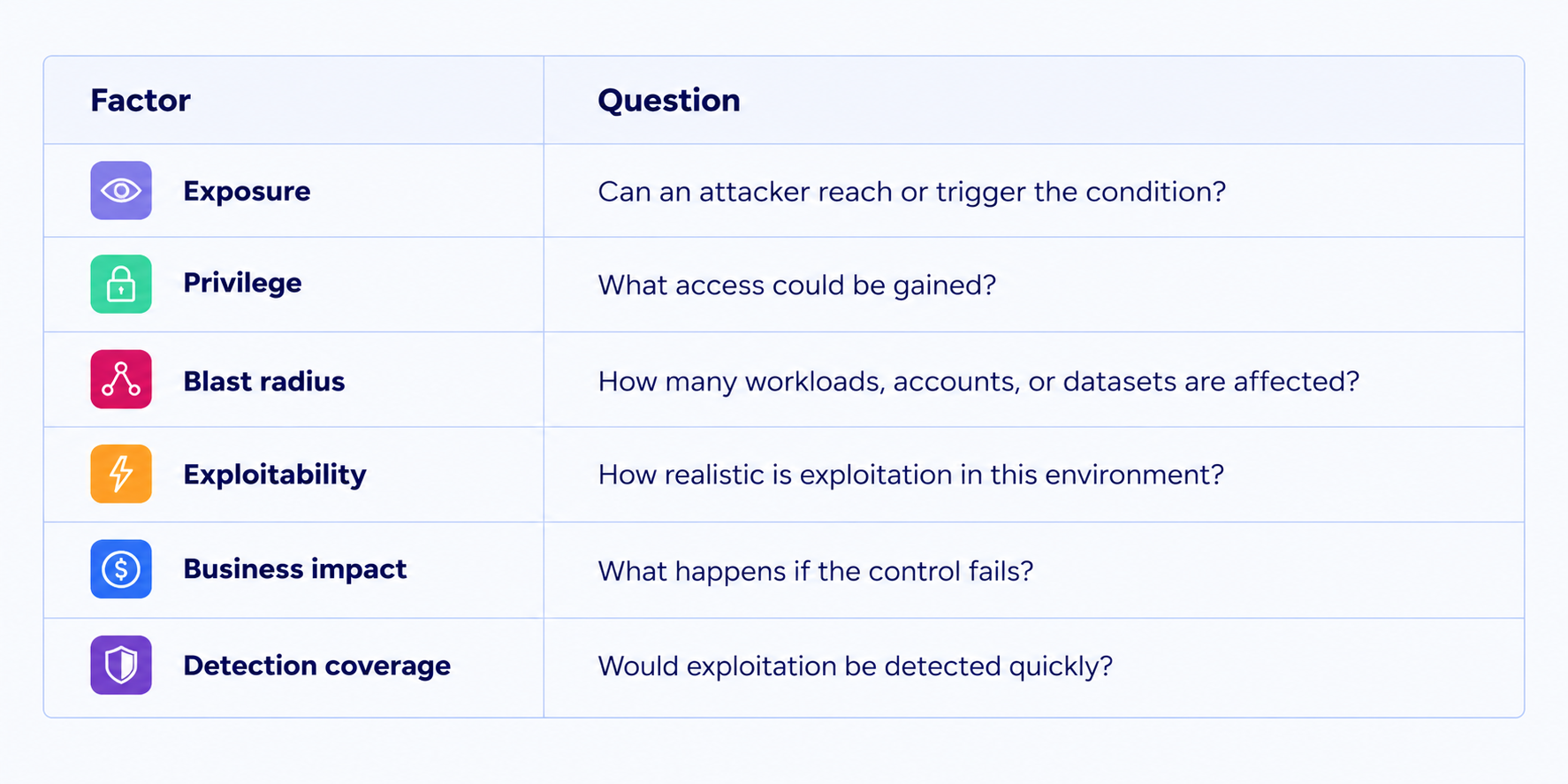
Internet-exposed administrative access with weak identity controls may require immediate remediation. Unused IAM role with broad external trust can be equally dangerous. Lower-risk configuration drift in an isolated development account may be scheduled instead.
Similar prioritization is important beyond security. OpsWorks' AWS Well-Architected Review uses architecture assessment to identify risks and turn findings into a practical remediation roadmap rather than an undifferentiated list of issues.
Manual AWS security hardening can improve an environment today and still leave it vulnerable six months later.
New accounts appear. Developers create roles. Security groups change. Third-party integrations receive permissions. New container images reach EKS. Temporary exceptions become permanent.
Security controls therefore need to move closer to infrastructure delivery. Infrastructure as Code provides a useful enforcement point because Terraform, CloudFormation, Kubernetes manifests, and platform templates describe security-sensitive infrastructure before it reaches production.
Policy checks can detect public resources, unrestricted administrative ports, missing encryption, excessive IAM permissions, missing logging, prohibited network paths, and privileged workloads before deployment.
Not every finding needs to block a release. High-confidence, high-impact violations are good candidates for enforcement. Lower-risk findings can become warnings or remediation tasks.
This is where AWS security hardening and DevSecOps should connect: one establishes infrastructure controls, while the other makes them repeatable within delivery workflows.
Threat detection without an incident process produces alerts rather than resilience. Critical AWS findings need an expected response path.
Response may involve credential revocation, role-session invalidation, network isolation, workload quarantine, secret rotation, evidence preservation, or escalation to application owners.
Automation works well when containment is deterministic and safe. Human approval remains appropriate when a response could disrupt production or destroy evidence. Recovery architecture matters too.
Security incidents may require restoring data, rebuilding infrastructure, rotating credentials, or failing over workloads. OpsWorks' AWS Disaster Recovery Strategy explains how RTO, RPO, backups, and recovery architecture affect the ability to restore production after serious failures. Security and resilience should be designed together.
Not every AWS environment needs the same first investment. Security roadmap should start with the control gap that creates the largest realistic risk.
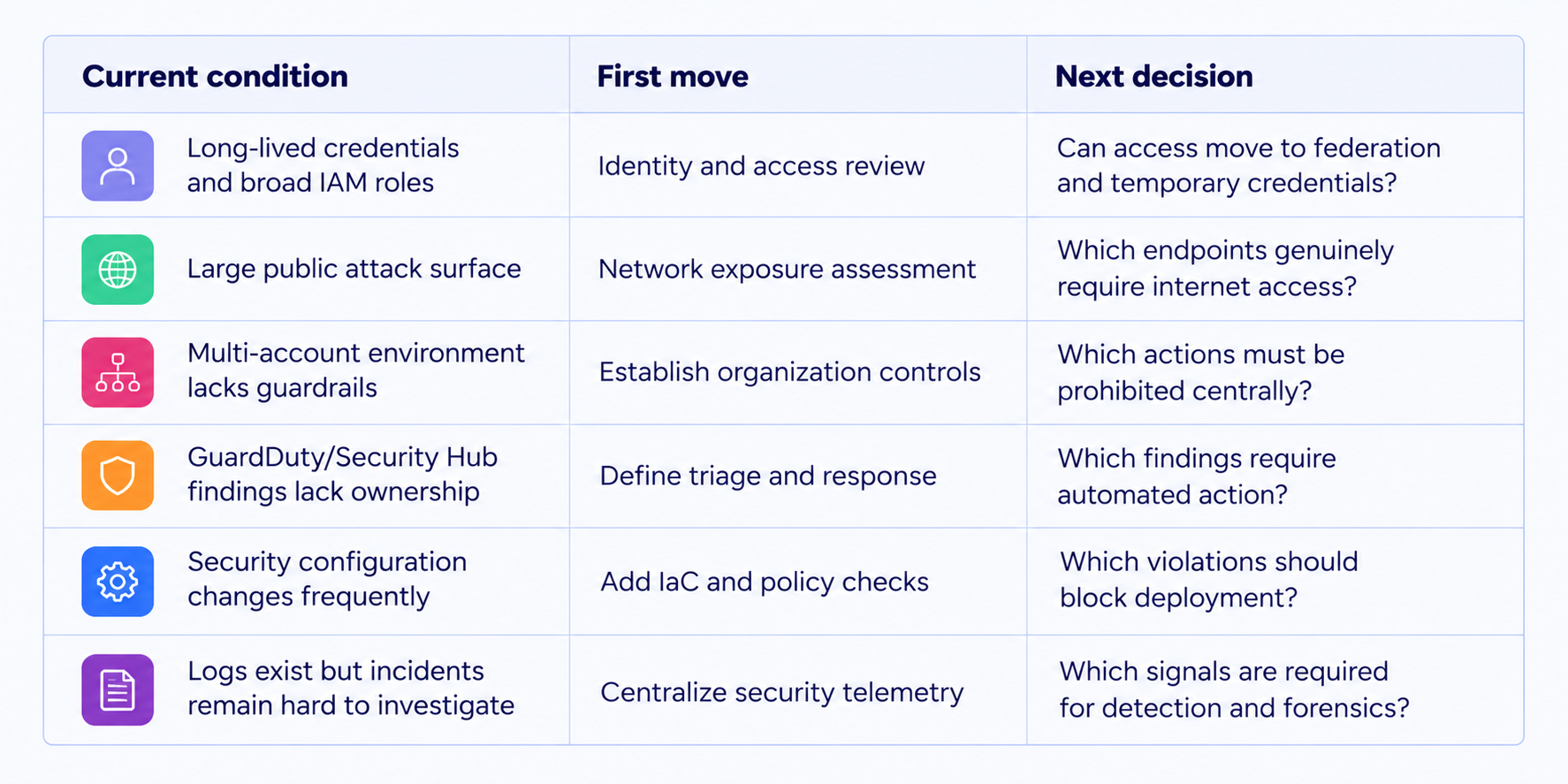
Sequence matters.
Team with excessive administrative permissions should usually address identity exposure before investing in advanced threat analytics. Environment with strong preventive controls but poor visibility may gain more from centralized detection and incident workflows.
Security maturity is not measured by how many AWS security services are enabled. It is measured by how effectively controls reduce attack paths and how quickly teams can detect and contain what gets through.
SOC 2, ISO 27001, PCI DSS, HIPAA, CIS Benchmarks, and other frameworks can require evidence around access management, encryption, logging, vulnerability management, incident response, and change control.
Passing an audit does not prove every relevant attack path is controlled. Better approach maps compliance requirements to technical controls already needed for production security.
IAM reviews can support access-control evidence. Centralized logging can support threat investigation and audit trails. Infrastructure as Code improves configuration consistency and change evidence. Vulnerability management can satisfy control requirements while reducing exploitable exposure.
OpsWorks' Security & Compliance services combine cloud security assessment with compliance audit preparation, security automation, secrets management, monitoring, and incident management so remediation addresses infrastructure risk rather than documentation alone.
AWS security becomes difficult when protection spans multiple accounts, EKS, CI/CD, IAM, networking, compliance, and production operations.
OpsWorks approaches security as an infrastructure engineering problem rather than a standalone scanner deployment.
Work can start with a cloud security assessment and compliance review to identify excessive permissions, network exposure, configuration gaps, monitoring weaknesses, vulnerabilities, and compliance risks.
Findings can then become a prioritized remediation roadmap.
For AWS environments requiring deeper protection, AWS Infrastructure Security Hardening adds threat detection, vulnerability assessment, GuardDuty, EKS audit log monitoring, runtime monitoring, and continuous security controls.
Objective is not to enable every available AWS security service. Objective is to reduce exploitable attack paths, limit blast radius, detect suspicious behavior earlier, and make security controls repeatable as infrastructure changes.
Secure AWS environment is not a finished architecture. Every new workload, integration, role, network path, deployment, and exception can change its security posture.
Effective AWS security follows a continuous cycle: assess risk, reduce unnecessary access and exposure, detect abnormal behavior, respond to findings, automate proven controls, and reassess after change.
IAM limits what identities can do. Network security limits what systems can reach. Logging and threat detection reveal behavior preventive controls did not stop. Incident processes determine how quickly exposure becomes contained. Strong AWS security emerges when those layers operate together.
Start with identity and access control, MFA, federation and temporary credentials, least privilege, controlled network exposure, encryption and secrets management, centralized logging, continuous threat detection, vulnerability management, and defined incident response. Priority should depend on actual attack paths and business impact.
AWS IAM best practices include federation for workforce access, temporary credentials and IAM roles for workloads, MFA, least-privilege policies, IAM Access Analyzer, permissions boundaries where administration is delegated, organization-level guardrails, and regular removal of unused permissions.
Identify which resources genuinely need public or cross-network access. Restrict unnecessary paths, configure security groups deliberately, segment workloads where appropriate, protect public applications with controls such as AWS WAF, and introduce centralized inspection where architecture and risk justify it.
Amazon GuardDuty is a core AWS threat detection service. Broader detection architecture can use CloudTrail for API activity, Security Hub for centralized findings and posture management, AWS Config for configuration visibility, and Amazon Inspector for vulnerability management.
No. GuardDuty provides threat detection but does not replace IAM hardening, network security, vulnerability management, secure configuration, logging, or incident response. Findings still require ownership, prioritization, and a defined response process.
Assessment should follow significant architecture changes, migrations, new regulatory requirements, major incidents, or substantial growth in accounts and workloads. Continuous controls should monitor high-risk configuration and security signals between formal assessments.

Subscribe to our newsletter and get the latest insights that help you stay ahead of the curve.

© 2017-2025 All rights are reserved


