




Telecom infrastructure has little tolerance for slow scaling or fragile dependencies. Traffic changes, services expand across regions, workloads become more distributed, and maintenance still has to happen without disrupting customer-facing systems.
Cloud solves the capacity problem only partially. Moving workloads to AWS or another provider does not automatically create telecom high availability or predictable scaling. Architecture, automation, workload placement, observability, and recovery determine whether infrastructure can absorb traffic growth and failures without service disruption.
Strong telco cloud infrastructure should do three things well: remain available when components fail, scale when demand changes, and automate enough of the operating model to make both behaviors repeatable.
Telecom systems rarely behave like one application with a predictable traffic curve. Infrastructure may support APIs, customer platforms, data processing, analytics, messaging, billing, and network-facing services with different latency and availability requirements. Demand can also change quickly by geography, service, event, or time.
Traditional capacity planning often compensates by provisioning for peak demand. Cloud infrastructure changes that model by making capacity programmable, but architecture must be able to use that flexibility.
Effective telecom network scalability requires infrastructure that can:
Key question is not simply how much infrastructure is needed, but how each workload should behave when demand changes or part of the platform fails.
High availability cloud architecture is not simply duplicated infrastructure.
Two application instances provide limited protection if both depend on one database, availability zone, network path, or manually maintained configuration.
Cloud infrastructure high availability should therefore be considered across multiple layers.
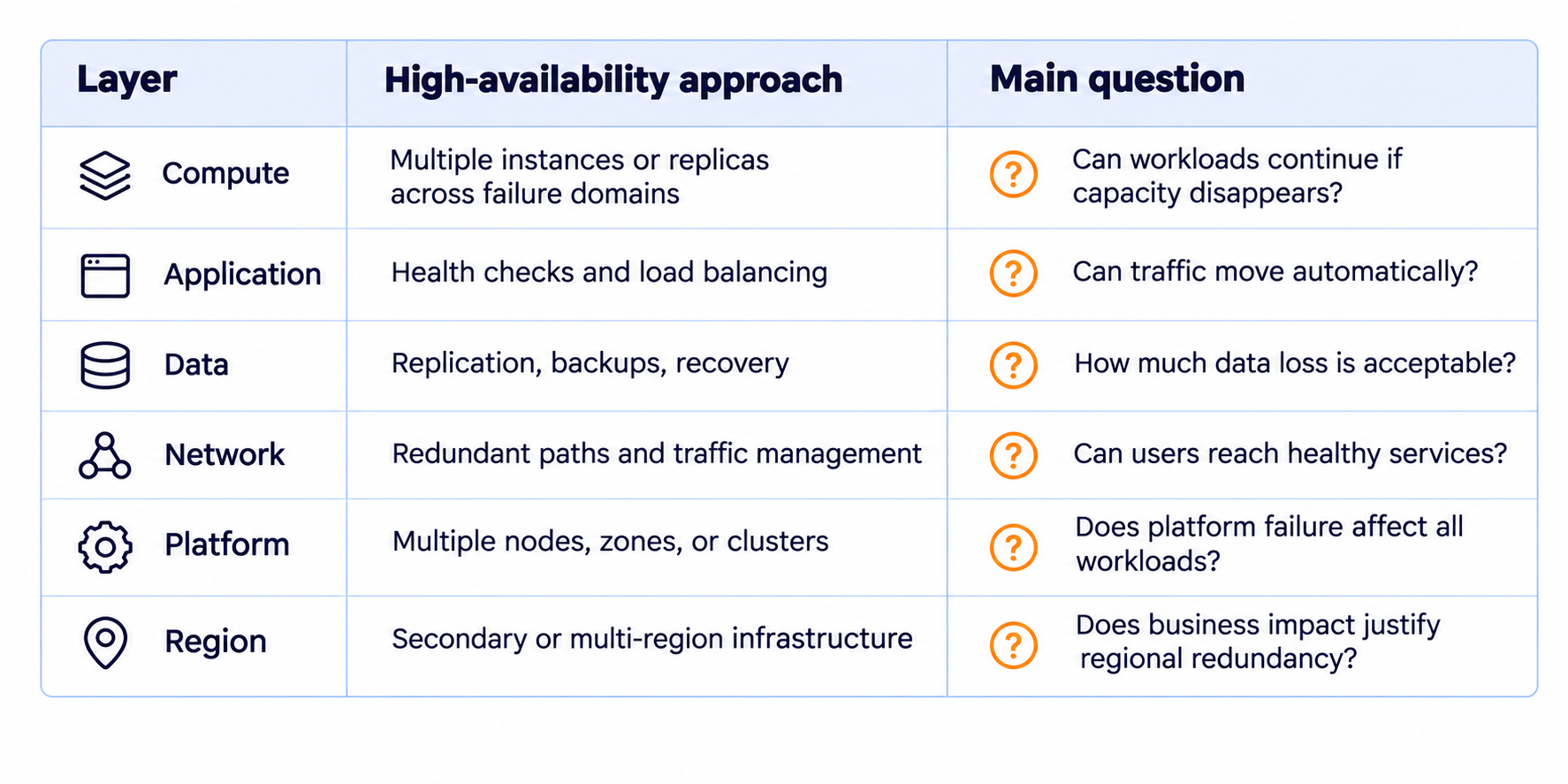
Goal is not maximum redundancy. Goal is removing failure modes that violate availability requirements.
Architecture decisions should start with service criticality, RTO, RPO, latency, and dependencies. OpsWorks covers these choices in AWS Disaster Recovery Strategy.
Multi-region cloud high availability can protect critical services against regional disruption, but it also adds data replication, traffic routing, deployment synchronization, observability, and failover complexity.
Active-active architecture makes sense when regional downtime creates unacceptable business impact. Other workloads may meet their requirements with Multi-AZ infrastructure and tested recovery in another region.
Decision should consider:
For Tier-1 environments, classifying workloads and assigning different resilience models is usually more effective than applying active-active architecture everywhere.
Scaling should not mean adding the same capacity everywhere.
One service may be CPU-bound while another depends on database connections, queue depth, network throughput, or external APIs. Auto scaling telecom infrastructure therefore needs signals that reflect actual workload behavior.
CPU and memory remain useful, but scaling can also incorporate request volume, latency, queue depth, concurrency, or application-specific metrics.
Cloud native telecom architectures allow services with different demand patterns to scale independently. This is especially valuable for high-volume APIs, event processing, analytics, and asynchronous workloads.
Infrastructure that scales up but rarely scales down turns temporary demand into permanent cost. Cooldown periods, minimum capacity, stateful workloads, and real traffic patterns should shape scale-in policies.
Cloud Cost Optimization Strategies explores how autoscaling, rightsizing, architecture, and cloud spend interact.
Load testing should verify how quickly capacity becomes available and whether databases, queues, load balancers, network limits, and external dependencies can support the same growth. Scaling compute successfully does not mean the system scales end to end.
Kubernetes can provide a strong foundation for cloud native telecom infrastructure by standardizing deployment, workload scheduling, service discovery, self-healing, and horizontal scaling.
Still, Kubernetes is not a high-availability strategy by itself. Poor node distribution, oversized workloads, shared dependencies, or weak observability can reproduce the same reliability problems inside a cluster.
Cluster topology should follow workload and failure boundaries. Some environments benefit from shared clusters; others require isolation between workloads, regions, or security domains.
For AWS environments, OpsWorks' Proven Reference AWS EKS Infrastructure combines Terraform, EKS, Helm, CI/CD, log aggregation, and monitoring into a reusable infrastructure baseline.
Large telecom environments become difficult to operate when infrastructure depends on tickets, manual configuration, or individual knowledge.
Infrastructure as Code makes networks, compute, Kubernetes, IAM, databases, and monitoring reproducible through version-controlled configuration. Changes can then be reviewed, tested, and deployed through controlled workflows.
This reduces configuration drift, improves traceability, and makes recovery easier. GitOps extends the same model by continuously reconciling environments with approved configuration stored in Git. GitOps for Cloud Infrastructure explains how this works in practice.
For telecom organizations with many services and teams, consistency becomes an operational control rather than a documentation exercise.
Infrastructure metrics alone cannot explain service health in distributed systems. Healthy CPU does not prove that a customer transaction works, and healthy Kubernetes nodes do not guarantee acceptable latency.
Observability should connect:
SLOs then help teams prioritize incidents according to service impact rather than alert volume. Cloud Observability Strategy explains how metrics, logs, traces, and SLOs can work together in distributed cloud systems.
5G increases pressure on telco cloud architecture through distributed processing, lower latency requirements, faster scaling, and edge workloads. But 5G cloud architecture should not mean distributing every service.
Latency-sensitive workloads may need to run closer to users or network edges, while centralized workloads can remain in regional cloud infrastructure where resource pooling is more efficient.
Architecture should therefore ask:
Which workloads need proximity, which need centralized scale, and which need both?
Placement should follow measurable latency, data, availability, security, and cost requirements. Same principle applies to the broader telco network cloud.
Telecom high availability also means remaining stable while teams deploy changes.
Rolling deployments, canary releases, blue-green deployments, health checks, and automated rollback can reduce the blast radius of failed releases.
Infrastructure changes need similar controls. CI/CD pipelines can validate Terraform, Kubernetes manifests, policies, and application artifacts before production.
Security should be integrated into the same workflow. OpsWorks' Security & Compliance services cover cloud security assessment, DevSecOps integration, security automation, secrets management, and monitoring.
Backups alone are not telecom disaster recovery.
Recovery architecture should begin with two questions:
How long can this service be unavailable?
How much data can the business afford to lose?
RTO and RPO determine whether a workload needs backup and restore, replicated infrastructure, warm standby, or active capacity in another region.
Recovery also needs testing. Infrastructure as Code can recreate resources, but successful recovery may still depend on data, DNS, secrets, certificates, routing, and external integrations.
High availability becomes expensive when every workload receives maximum redundancy and permanent spare capacity.
Predictable workloads may benefit from committed capacity. Variable services can use autoscaling. Fault-tolerant processing may use interruptible capacity. Non-critical systems may not require the same regional redundancy as customer-facing services.
Cost decisions should follow workload value. Removing necessary redundancy creates risk. Keeping oversized infrastructure running because traffic is unpredictable creates waste. Strong architecture balances both.
No single telco cloud platform design fits every service.
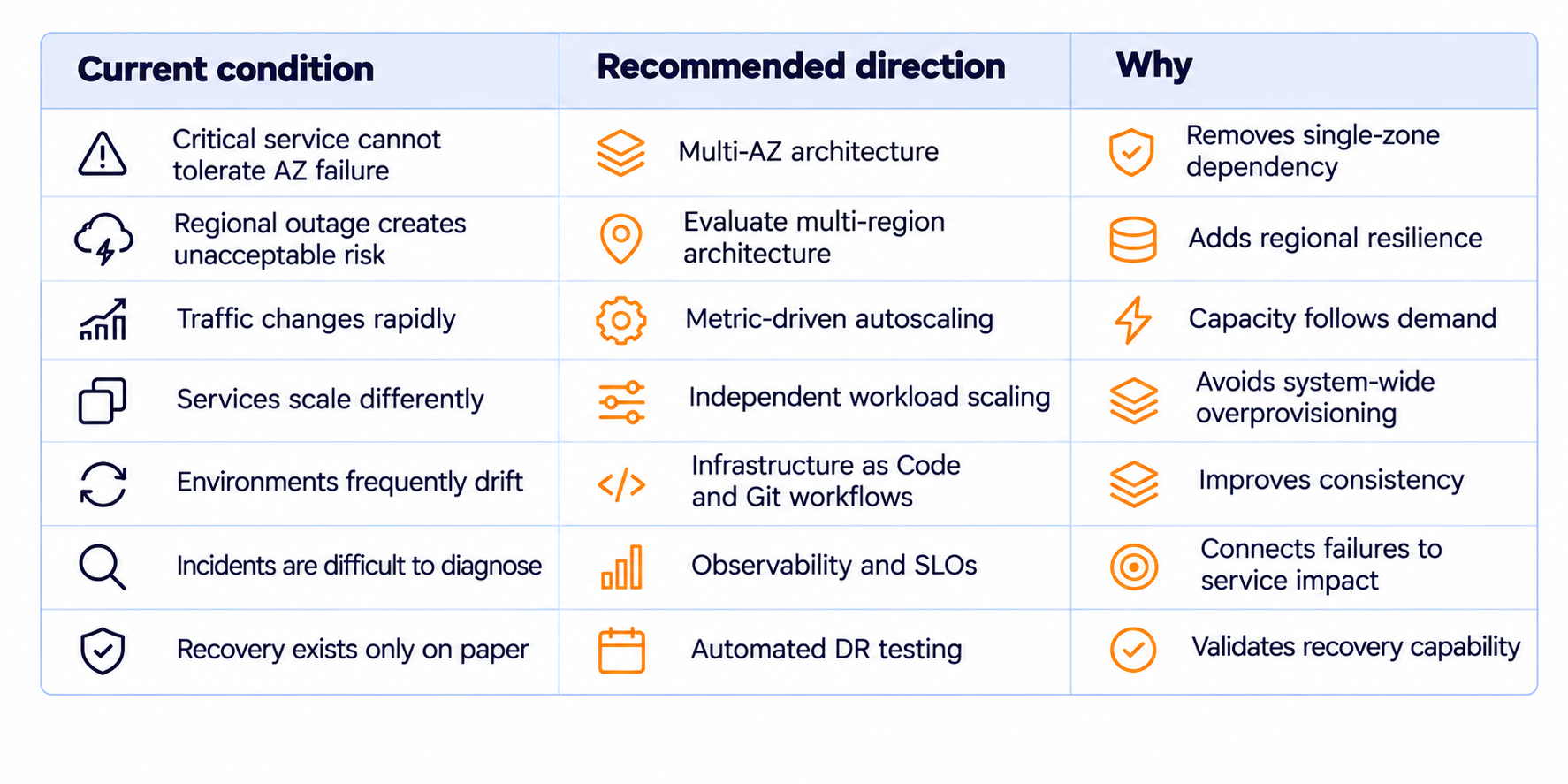
Architecture should be evaluated against availability, latency, scalability, recovery, operational complexity, and cost together.
Telecom cloud modernization becomes difficult when infrastructure has to remain reliable while workloads, traffic, architecture, and teams continue changing.
OpsWorks supports these environments through Cloud Adoption and DevOps Transformation, covering cloud architecture, Kubernetes, CI/CD, Infrastructure as Code, automation, monitoring, scalability, and operational improvements.
Work can start with existing infrastructure rather than forcing a complete platform replacement. Typical engagement includes workload and architecture assessment, infrastructure automation, scalability improvements, observability, recovery, and knowledge transfer.
Telecom experience also matters. In the Vodafone case study, OpsWorks worked across AWS, Kubernetes, automation, monitoring, and existing enterprise processes, resulting in a reported 40% improvement in infrastructure efficiency.
For Tier-1 telecom organizations, goal is not simply moving more infrastructure to cloud. Goal is making infrastructure easier to scale, recover, change, and operate.
Telco cloud infrastructure is cloud-based or cloud-native infrastructure used to run telecom applications, platforms, network-related services, data processing, and supporting workloads. It can combine public cloud, Kubernetes, automation, networking, storage, observability, and security.
Telco cloud architecture defines how telecom workloads, compute, networking, storage, availability mechanisms, and operational tooling are structured. Strong architecture considers latency, scalability, failure isolation, automation, recovery, security, and cost together.
Cloud infrastructure high availability typically combines workload redundancy, multiple failure domains, health checks, load balancing, resilient data layers, monitoring, and automated recovery. Multi-region architecture adds regional resilience where business requirements justify its complexity.
Cloud traffic spikes can be handled through horizontal scaling, load balancing, workload isolation, queue-based processing, capacity buffers, and autoscaling based on relevant infrastructure or application metrics.
Auto scaling telecom infrastructure automatically adjusts capacity according to workload demand. Signals can include CPU, memory, request rate, latency, queue depth, concurrency, or application-specific metrics.
Kubernetes can support cloud native telecom workloads that benefit from container orchestration, independent scaling, standardized deployment, and self-healing. Suitability still depends on networking, latency, state, security, and operational requirements.
Not always. Multi-region cloud high availability is most useful when regional failure would exceed acceptable downtime or business risk. Many workloads can meet their requirements with Multi-AZ infrastructure and tested disaster recovery.
5G cloud architecture can increase demand for distributed workloads, low-latency processing, automation, rapid scaling, and edge deployment. Workloads should still be distributed according to measurable technical and business requirements.
Strong starting points are infrastructure provisioning, configuration, CI/CD, scaling, monitoring, and recovery. Infrastructure as Code provides a foundation by making infrastructure state reproducible and auditable.
Telco cloud managed services provide ongoing support for cloud infrastructure operations and improvement. Scope may include Kubernetes, monitoring, automation, incident response, security, optimization, and infrastructure modernization.


Subscribe to our newsletter and get the latest insights that help you stay ahead of the curve.

© 2017-2025 All rights are reserved


