




Cloud architecture can look healthy while hiding expensive weaknesses. Workloads may run without tested recovery, IAM permissions may be broader than necessary, scaling may depend on manual decisions, observability may stop at infrastructure metrics, and cloud spend may increase without clear business value.
AWS Well-Architected Review helps expose those gaps before they become outages, security incidents, performance bottlenecks, or unnecessary costs. Real value does not come from answering framework questions. Value comes from turning findings into priorities and priorities into measurable improvements.
This guide explains how to use the AWS Well-Architected Framework as a practical cloud architecture assessment: what its six pillars evaluate, which risks deserve attention first, and how to build a remediation roadmap.
AWS Well-Architected Framework provides a structured way to evaluate cloud architecture against AWS best practices.
Well-Architected Review applies those principles to a specific workload across architecture, operations, security, reliability, performance, cost, and sustainability.
Difference between a useful review and a checkbox exercise appears after findings are identified.
Weak review says:
“Workload has a reliability risk.”
Useful review explains:
“Database recovery is not tested against required RTO, infrastructure recreation depends on manual configuration, and secondary environment parity is not validated.”
Second version gives engineering teams something actionable.
OpsWorks approaches the AWS Well-Architected Review from that perspective: assessment is followed by prioritization, risk mitigation, and implementation support.
Six AWS Well-Architected Framework pillars cover different dimensions of architecture quality.
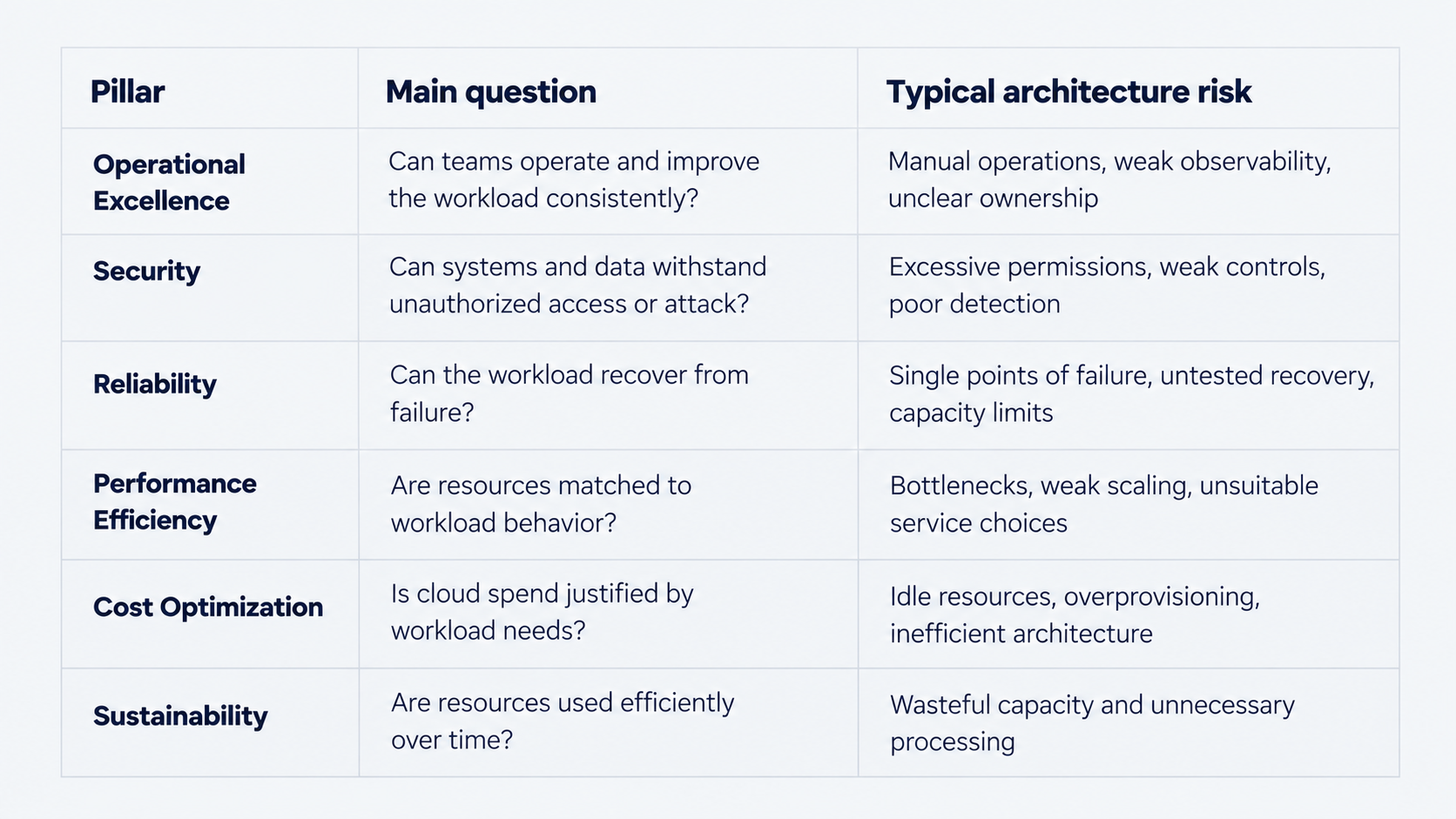
Pillars should not be treated independently. Cost reduction can weaken reliability. Higher availability can increase cost and complexity. Security controls can affect delivery workflows. Performance improvements can change infrastructure spend. Strong architecture review evaluates those trade-offs together.
Operational Excellence evaluates how effectively teams run, monitor, and improve workloads.Technically sound infrastructure can still be fragile if deployments are manual, incident procedures are undocumented, environments differ, or service ownership is unclear.
Review should examine how changes are delivered, how incidents are detected, and whether operational improvements are repeatable.
OpsWorks' DevOps Maturity Model provides a useful supporting perspective because automation, ownership, monitoring, and architecture quality usually evolve together.
Security pillar evaluates identity, data protection, infrastructure protection, detection, and incident response. Common risks include overprivileged IAM roles, long-lived credentials, inconsistent secrets management, incomplete logging, weak network controls, and missing automated security checks.
OpsWorks' Security & Compliance practice covers cloud security assessment, DevSecOps, security automation, secrets management, and compliance support.
Teams can also use the DevSecOps implementation guide to connect architecture risks with CI/CD security controls.
Reliability asks whether a workload can continue operating or recover when components fail. Review should look beyond whether backups exist. Recovery objectives, redundancy, service quotas, dependency failures, automated recovery, capacity planning, and disaster recovery testing all matter.
OpsWorks' guide to AWS Disaster Recovery explains how RTO, RPO, Multi-AZ, backup, warm standby, and multi-Region architecture should be matched to business requirements. Reliability finding becomes actionable only when failure scope and acceptable business impact are clear.
Performance Efficiency evaluates whether architecture uses suitable resources and adapts to demand. Problems do not always appear as slow applications.
Oversized instances can hide inefficiency. Static capacity can hide weak autoscaling. Database design can become a bottleneck while compute stays underutilized. Useful review connects infrastructure metrics with application behavior and business demand.
OpsWorks' Cloud Observability Strategy explains how metrics, logs, traces, and SLOs help identify where performance actually degrades.
Cost Optimization asks whether infrastructure spend supports measurable workload requirements. Architecture can create unnecessary costs through duplicate environments, inefficient data transfer, oversized databases, excessive telemetry, or poor storage policies.
OpsWorks' Cloud Cost Optimization guide covers rightsizing, pricing models, FinOps, automation, and architecture optimization.
Better question than “Where can we cut?” is:
“What is the most efficient architecture that still satisfies reliability, security, performance, and growth requirements?”
Sustainability focuses on reducing unnecessary resource consumption while maintaining workload requirements.
Unused environments, inefficient compute, excessive retention, and unnecessary processing can increase both cost and environmental impact. Most improvements come from better workload design rather than isolated optimization tasks.
AWS Well-Architected Framework checklist can produce many findings. Treating all of them as equally urgent creates an unmanageable backlog.
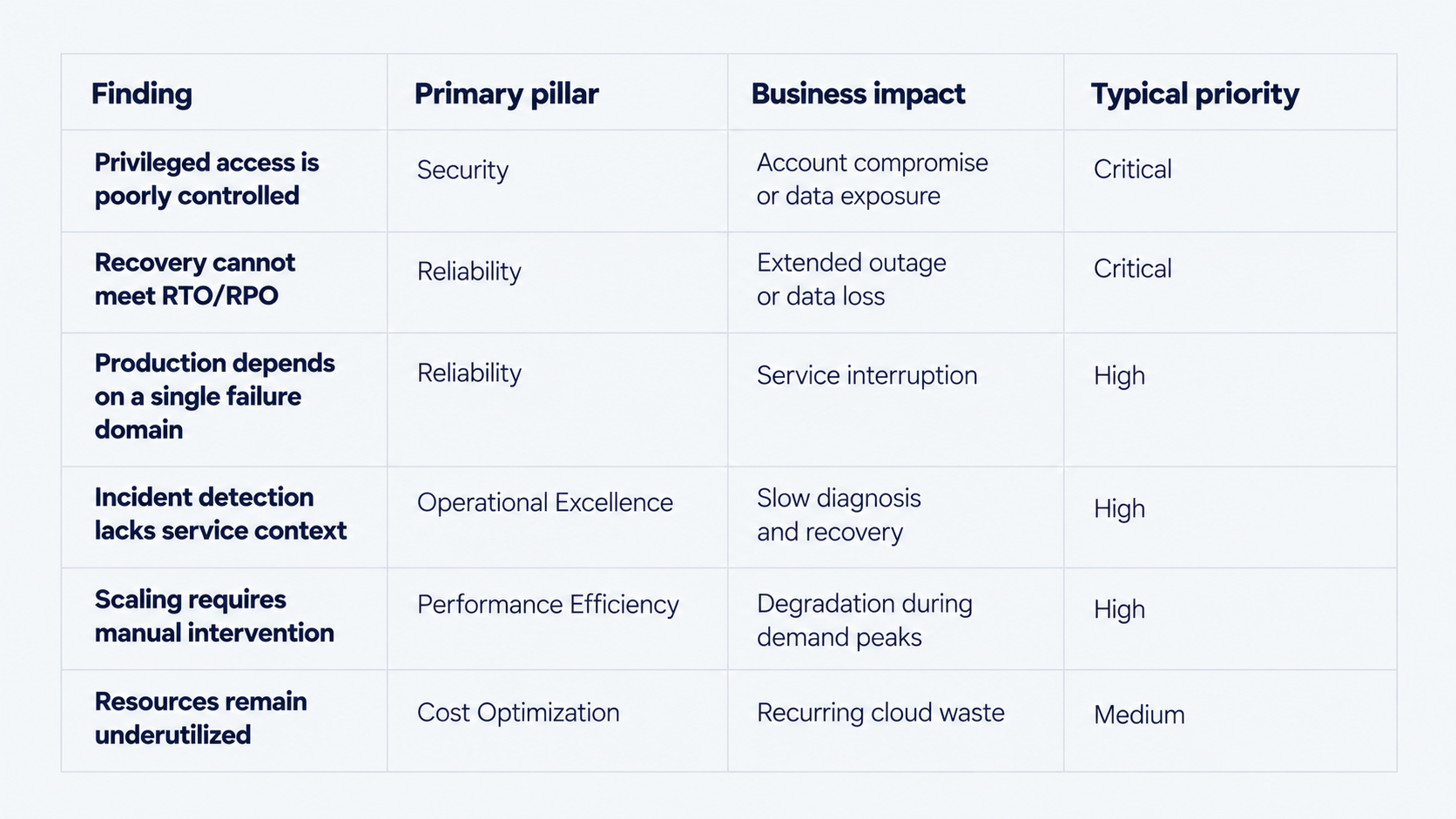
Context still matters. Missing multi-Region architecture is not automatically critical if workload requirements are already satisfied by Multi-AZ.
Prioritization should reflect workload criticality, business impact, and likelihood rather than framework category alone.
Cloud architecture assessment becomes more useful when every finding is evaluated through four factors:
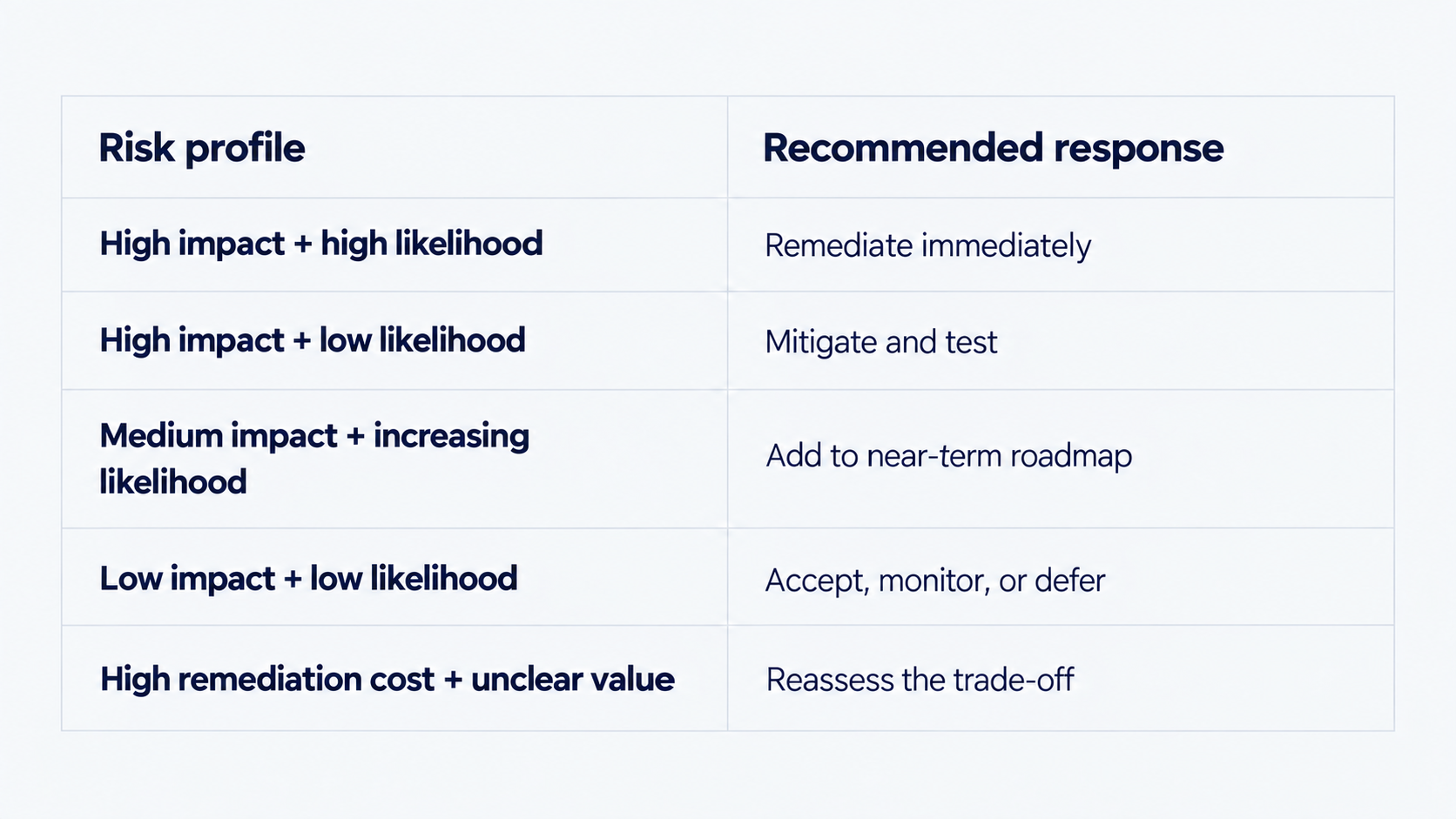
This approach prevents teams from fixing easy low-value issues while larger architecture risks remain untouched.
Review should end with an engineering roadmap, not a static report.
Useful sequence is:
Dependencies matter.
Rightsizing before understanding workload behavior can create capacity problems. Reducing redundancy before defining RTO can weaken resilience. Adding more monitoring tools before fixing instrumentation can create more data without better visibility. Infrastructure as Code often becomes a foundation for several improvements at once.
OpsWorks' GitOps for Cloud Infrastructure explains how version-controlled infrastructure and automated reconciliation reduce drift and improve repeatability.
AWS Well-Architected Review should not become a service-by-service configuration audit.
Perfectly configured EC2 instances do not solve application-level single points of failure. Encrypted databases do not guarantee appropriate access. Working dashboards do not guarantee useful incident detection. System behavior matters more than isolated configuration.
Review should follow complete workload paths across application processing, data access, infrastructure dependencies, deployment, monitoring, failure handling, and recovery.
Internal teams can use AWS Well-Architected Framework directly. External assessment becomes more valuable as architecture complexity increases.

Independent review can challenge assumptions that internal teams have normalized over time. OpsWorks' AWS Well-Architected Review includes assessment across all six pillars, opportunities identification, risk mitigation, prioritization, and implementation support.
OpsWorks works with AWS environments where architecture findings need to become engineering changes rather than recommendations waiting in a backlog.
AWS Well-Architected Review can connect directly with DevOps Transformation, Security & Compliance, cloud monitoring, Infrastructure as Code, CI/CD, performance optimization, and cost optimization.
Engagement can begin with existing architecture rather than a redesign. Teams review workload requirements, AWS configuration, operations, security controls, reliability patterns, performance data, and cost behavior. Findings are then prioritized by risk and business value.
Some environments need architectural changes. Others need better automation, observability, IAM controls, recovery testing, or cost governance.
Goal is not maximum complexity. Goal is architecture that is deliberate, measurable, and appropriate for the business.
Strong Well-Architected practice is continuous rather than event-driven. Teams should revisit architecture when workload behavior changes, new services are introduced, compliance requirements evolve, traffic grows, or reliability expectations become stricter.
Five practices make reviews more useful:
Framework then becomes part of architecture governance instead of an occasional assessment.
AWS Well-Architected Framework does not define one perfect cloud architecture.
Different workloads need different levels of reliability, security, performance, automation, and cost efficiency.
Strong architecture can explain those decisions. Teams know why redundancy exists, which failures are acceptable, why capacity is sized a certain way, which risks are accepted, and which improvements matter next.
AWS Well-Architected Review provides structure for asking those questions. Remediation turns answers into engineering value. Architecture should not simply pass a review.
It should become easier to operate, safer to change, faster to recover, and more efficient as the business grows.
AWS Well-Architected Review evaluates a workload against AWS architecture best practices and identifies improvements across operations, security, reliability, performance, cost, and sustainability.
Six pillars are Operational Excellence, Security, Reliability, Performance Efficiency, Cost Optimization, and Sustainability.
No. Review is an architecture assessment focused on identifying risks, trade-offs, and improvement opportunities rather than a formal compliance audit.
Review should be repeated after major migrations, architecture changes, rapid growth, repeated incidents, security changes, or material increases in cloud cost.
Findings should be prioritized by impact, likelihood, urgency, effort, and dependencies. Critical security and reliability risks usually come first, followed by operational, performance, cost, and sustainability improvements.


Subscribe to our newsletter and get the latest insights that help you stay ahead of the curve.

© 2017-2025 All rights are reserved


