




Production failure is a bad time to discover that a backup restores too slowly, a secondary Region is missing dependencies, or nobody knows who should trigger failover.
AWS provides enough resilience services to build almost any recovery model. Hard part is deciding how much downtime and data loss the business can tolerate, then designing an AWS disaster recovery strategy that can actually meet those limits.
Strong disaster recovery in AWS starts with RTO and RPO, not with architecture diagrams. From there, teams can choose between backup and restore, pilot light, warm standby, or multi-Region architecture.
Recovery Time Objective defines how long a workload can remain unavailable. Recovery Point Objective defines how much recent data the business can afford to lose. These objectives determine the architecture.
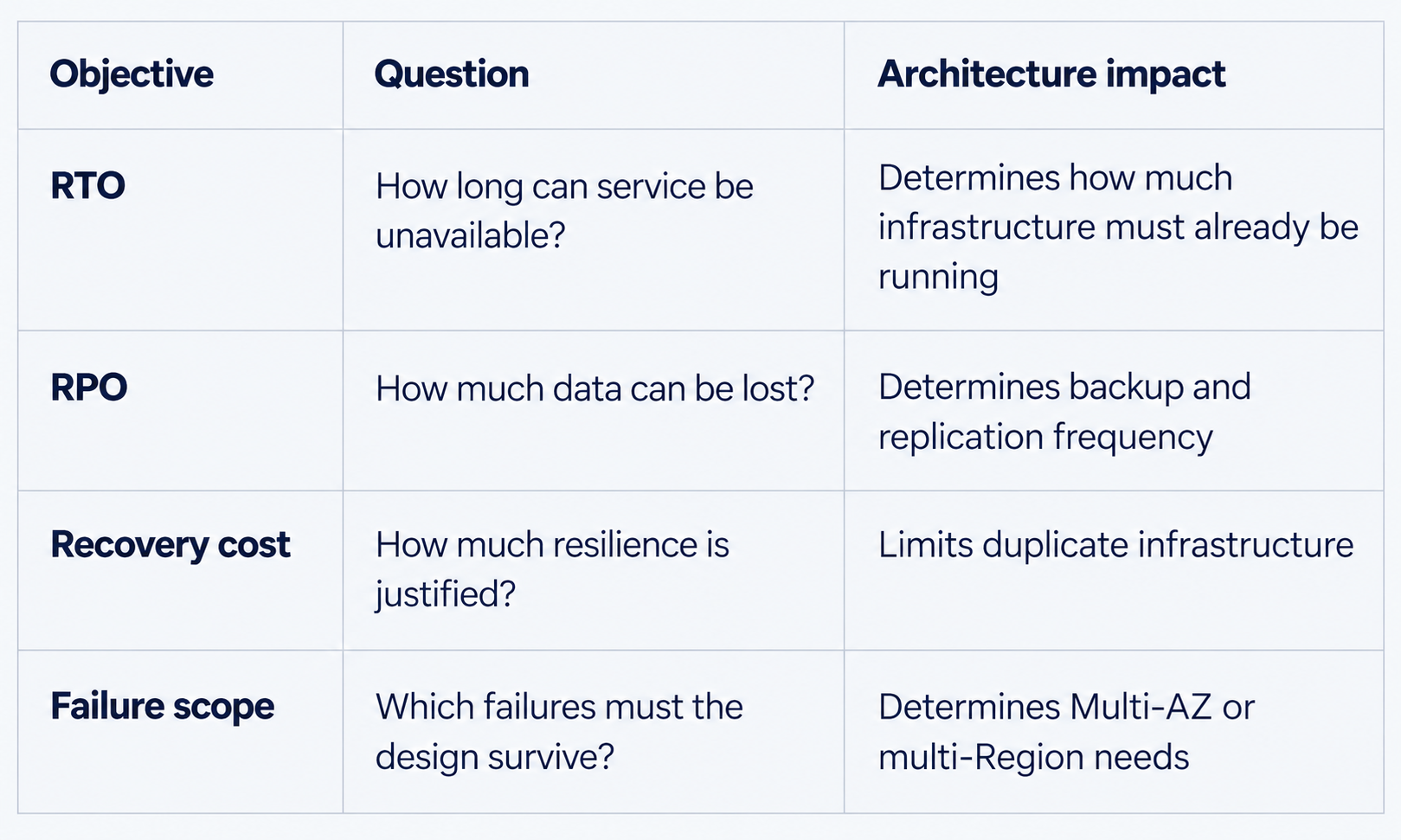
Customer-facing payments may need recovery in minutes with minimal data loss. Internal reporting may tolerate hours. OpsWorks' DevOps Maturity Model makes the same broader point: reliability depends on measurable objectives, automation, monitoring, and ownership.
AWS disaster recovery architecture usually follows one of four models.
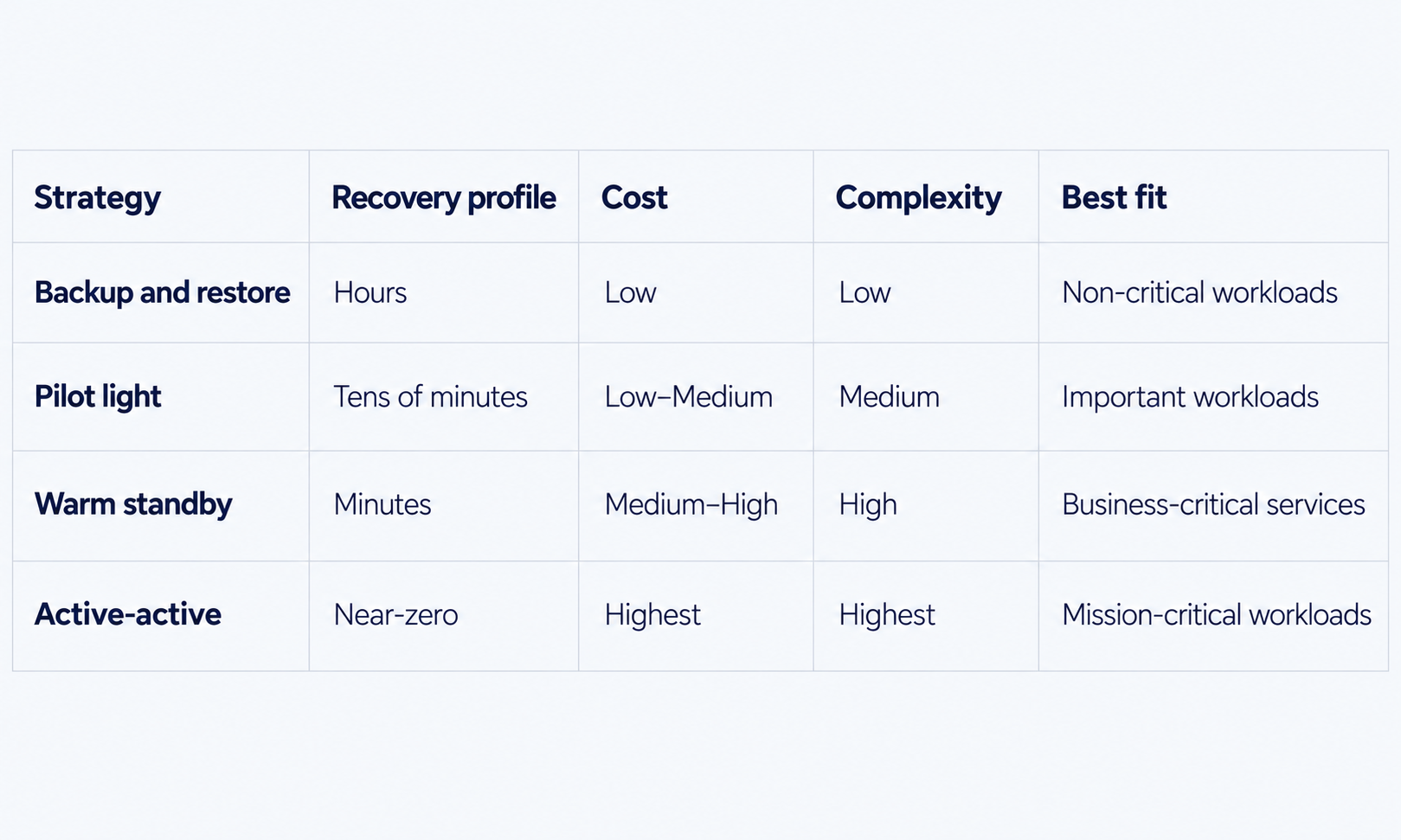
Actual RTO and RPO still depend on application design, data services, automation, networking, and testing.
Backup and restore is the simplest AWS backup disaster recovery model. Data is protected through snapshots, backups, object versioning, or similar mechanisms. Infrastructure and application services are recreated after failure.
Low cost makes this attractive when recovery measured in hours is acceptable. Risk appears during restore. Rebuilding infrastructure, restoring data, validating IAM, updating DNS, and confirming application integrity all consume time.
Infrastructure as Code reduces that uncertainty. OpsWorks' GitOps for Cloud Infrastructure explains why version-controlled infrastructure and automated reconciliation improve repeatability.
Pilot light keeps critical recovery components available while other resources are launched only during failover.
Data stores, replication, and core dependencies remain active. Compute capacity can be added during recovery. Compared with backup and restore, RTO improves significantly.
Main challenge is keeping production and recovery environments synchronized. Infrastructure changes, application versions, policies, and dependencies need to stay aligned.
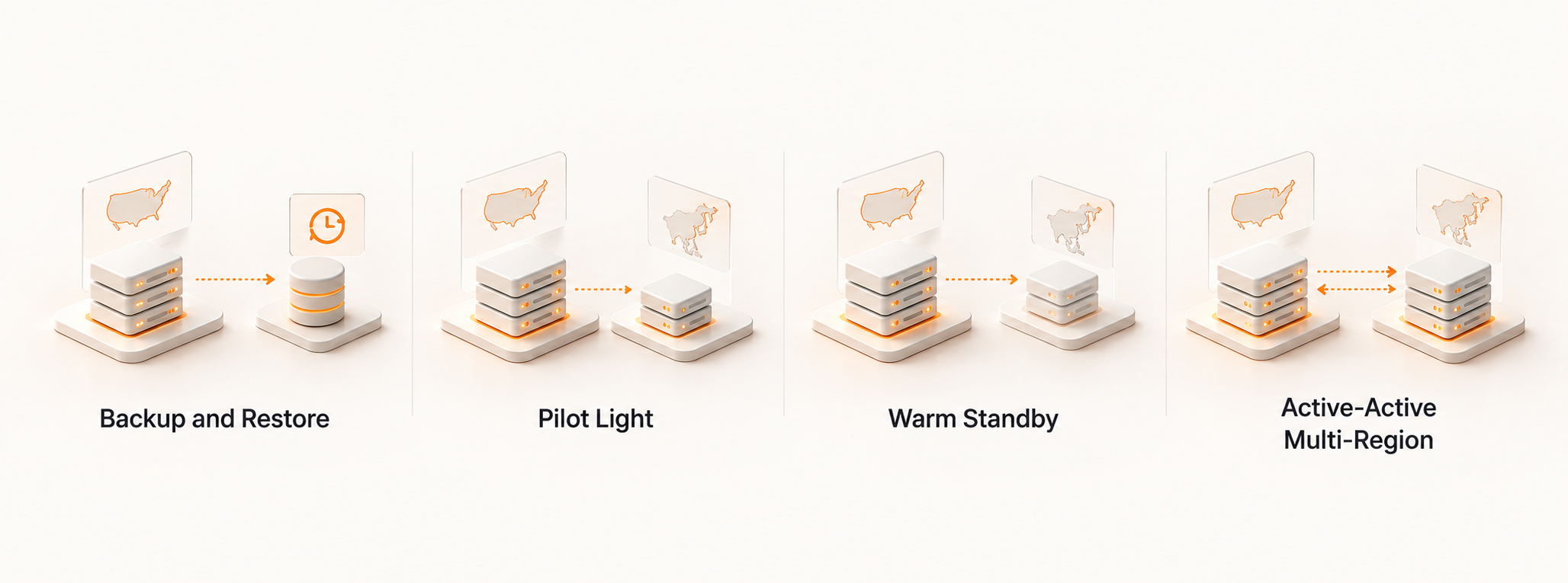
Warm standby keeps a complete but smaller production-capable environment running in another Region.
Data remains replicated, core services stay active, and recovery mainly requires traffic switching and scaling. Model fits workloads that need recovery within minutes.
Higher readiness means higher operating cost because teams maintain duplicated infrastructure, networking, monitoring, security controls, and software versions.
AWS multi Region disaster recovery reaches its strongest form when multiple Regions actively serve production traffic. Recovery can approach near-zero for some failures because workload capacity already exists in multiple Regions.
Complexity rises sharply. Applications need cross-Region traffic management, distributed data, synchronized infrastructure, consistent deployments, security parity, and observability.
Replication also does not replace backup. Accidental deletion or corrupted data can propagate between Regions. Multi-Region should therefore complement backup, not replace it.
One common AWS disaster recovery mistake is treating multi-Region as the default definition of resilience. Well-designed Multi-AZ architecture already covers many availability requirements.
Multi-Region becomes more relevant when workloads need protection from Regional disruption, strict recovery objectives, geographic separation, or global traffic distribution.
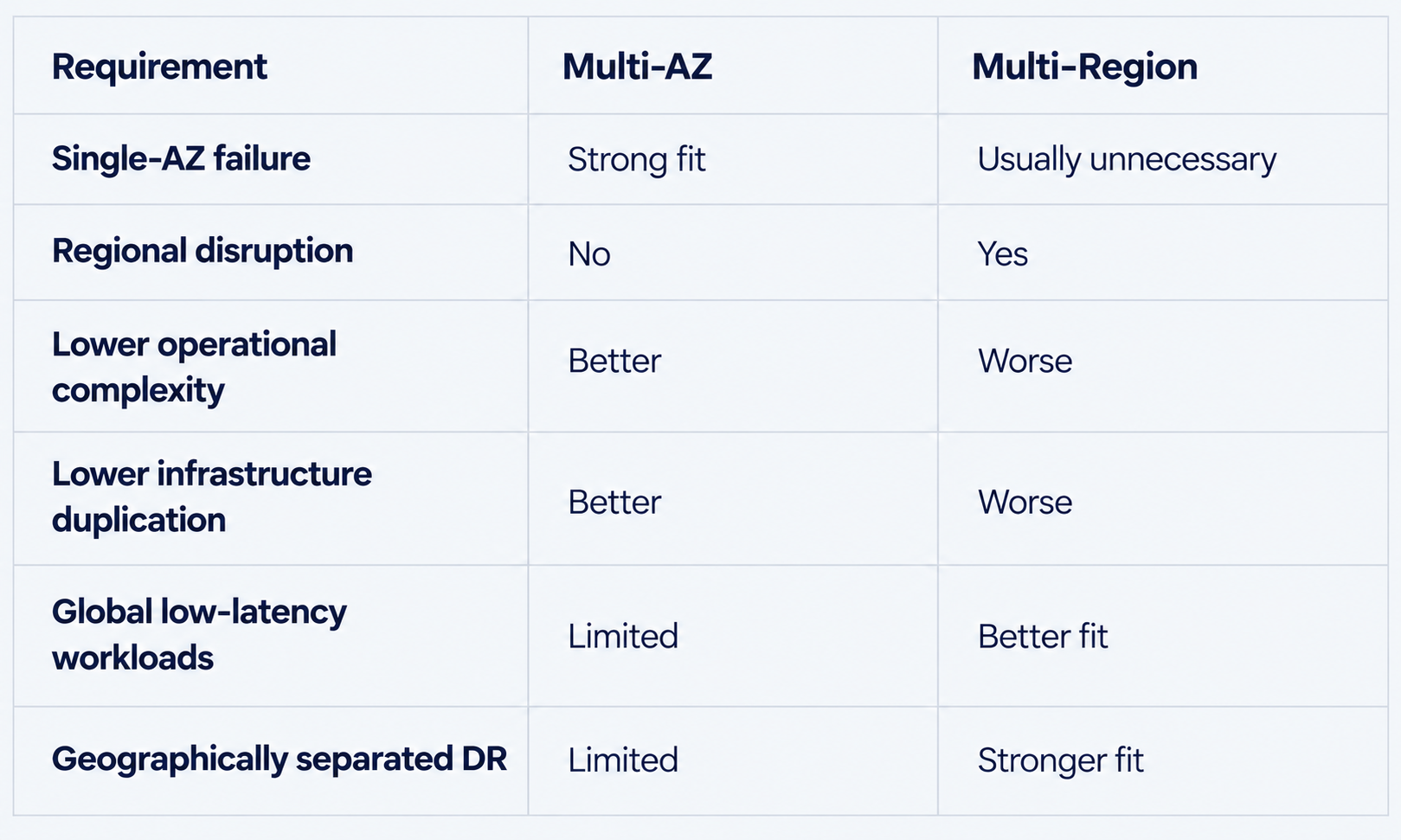
More infrastructure does not automatically create more resilience. Multi-Region adds data transfer, duplicated resources, synchronization, operational overhead, and additional failure modes.
Backup answers whether data can be recovered. Disaster recovery must answer whether the business service can be restored within agreed RTO and RPO.
Recovery also depends on infrastructure definitions, application artifacts, IAM policies, secrets, certificates, networking, monitoring, and third-party integrations. Restore procedures should therefore be tested.
Backup that has never been restored proves that data was copied. It does not prove that recovery works.
Failover should influence architecture from the beginning. Routing needs health signals. Applications need readiness checks. Databases need defined promotion behavior. Recovery environments need enough capacity to receive traffic.
False failover is also a risk. Single failed instance should not automatically trigger Regional failover. Recovery logic should reflect the failure scenarios the architecture was designed to handle.
AWS disaster recovery should be observable before it is needed. Teams should know whether backups completed, replication remains healthy, recovery infrastructure drifted, certificates are valid, and service quotas are sufficient.
Useful DR monitoring covers:
OpsWorks' Cloud Adoption services combine Cloud Backup & Disaster Recovery, Cloud Monitoring, Cloud Infrastructure Support, and AWS Well-Architected Review, allowing recovery readiness to be treated as an operating capability rather than a one-time project.
Lower RTO usually costs more because faster recovery requires more infrastructure to exist before an incident.
Backup and restore minimizes idle capacity but increases recovery time. Warm standby keeps more resources available. Active-active uses the most infrastructure because multiple environments serve production continuously.
OpsWorks' Cloud Cost Optimization guide explains why cloud cost is often an architectural issue. Disaster recovery follows the same pattern.
Best option is not the cheapest or fastest model. Best option is the least expensive architecture that reliably meets business recovery requirements.
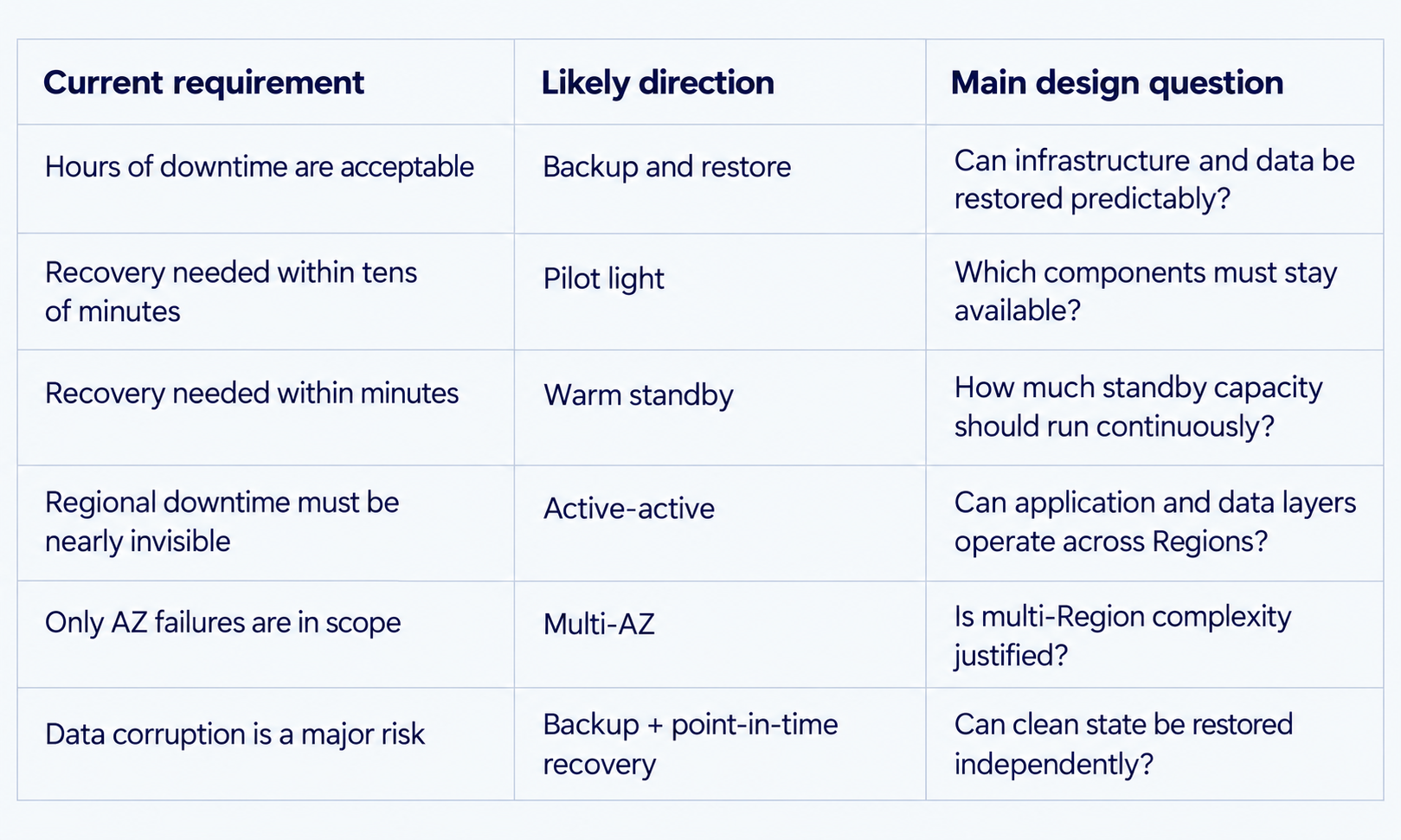
Different workloads can use different DR strategies. Internal systems may use backup and restore, while customer-facing workloads use pilot light or warm standby. Uniform recovery architecture is rarely necessary.
Manual runbooks become risky when recovery depends on many exact steps under pressure.
Practical AWS disaster recovery best practices include:
Automation also makes DR exercises faster and more repeatable.
DR tests should validate more than whether the application starts. Measure detection, decision-making, infrastructure recovery, data restore, traffic switching, and application validation.
Tests should cover realistic failures such as Regional outage, database corruption, broken configuration, compromised credentials, or unavailable dependencies. Results should feed back into architecture.
Missed RTO may require more automation or standby capacity. Missed RPO may require different backup or replication settings.
Recovery environments need the same IAM, secrets handling, network controls, logging, vulnerability management, and deployment policies as production. Otherwise, failover can restore availability while weakening security.
OpsWorks' DevSecOps implementation guide explains how security controls should be integrated into infrastructure and delivery. Same principle applies to recovery environments.
GitOps, CI/CD, and Infrastructure as Code also help prevent primary and recovery environments from drifting apart.
AWS disaster recovery projects often begin with a backup requirement and expose broader architectural questions.
Which workloads are truly critical? Which RTO and RPO targets are realistic? Is Multi-AZ enough? Which applications justify AWS multi Region architecture? Can infrastructure be recreated automatically?
OpsWorks' Cloud Adoption services include Cloud Backup & Disaster Recovery, Cloud Monitoring, Cloud Infrastructure Support, and AWS Well-Architected Review.
Engagement can start with assessing current recovery objectives, backup policies, failure domains, infrastructure automation, monitoring, and runbooks. Some systems may only need tested backups and better automation. Others may require pilot light, warm standby, or multi-Region design. Goal is not maximum redundancy. Goal is recovery architecture that meets business requirements without paying for unnecessary complexity.
AWS provides the building blocks for resilient systems, but resilience is not created by enabling backups or duplicating infrastructure alone.
Strong AWS disaster recovery strategy connects RTO, RPO, architecture, automation, monitoring, cost, and regular testing.
RTO defines how quickly service must return. RPO defines how much data can be lost. Backup protects recoverable state. Replication reduces recovery gaps. Multi-Region extends the failure boundary when business requirements justify it.
Most important question remains simple:
“Can your team prove the workload can recover within the limits the business agreed to?”
If recovery still depends on assumptions, manual steps, or an untested environment, disaster recovery remains a plan rather than a capability.



Subscribe to our newsletter and get the latest insights that help you stay ahead of the curve.

© 2017-2025 All rights are reserved


