



CI/CD pipeline can deploy an application to production in minutes. It can also deliver a vulnerable dependency, exposed secret, misconfigured container, or insecure infrastructure change just as quickly. That is the problem DevSecOps implementation is supposed to solve.
But adding every available security scanner to a pipeline is not the answer. If every finding blocks a release, developers start bypassing controls. If nothing blocks a release, security automation becomes reporting rather than protection. And if security reviews still happen manually at the end of the delivery process, adding “DevSecOps” tools has changed very little.
Real engineering problem is deciding where security controls belong, what they should detect, which findings should stop delivery, and where human judgment is still required. This guide explains how to build security into CI/CD pipelines without turning security into a delivery bottleneck.
Effective DevSecOps implementation does not mean running as many security tools as possible. It means placing the right controls at the right stage of software delivery and giving each control a clear enforcement policy.
Practical DevSecOps pipeline typically combines source-code and dependency analysis, secrets detection, Infrastructure as Code scanning, container scanning, dynamic testing, deployment policies, runtime monitoring, and auditable approval gates.
Key design decision is enforcement. Critical secrets, exploitable vulnerabilities, prohibited infrastructure configurations, and production policy violations may justify blocking a pipeline. Lower-confidence or lower-risk findings often belong in warnings, tickets, or remediation backlogs.
Automation should handle repeatable checks. Humans should make decisions that require business context, risk acceptance, architectural judgment, or exceptional production access. The objective is not “shift security left” at any cost. It is to make security controls fast enough, predictable enough, and relevant enough that secure delivery becomes the default path.
DevSecOps integrates security into the software delivery lifecycle rather than treating it as a separate review before production. That distinction matters. Traditional security processes often concentrate validation near the end of delivery. A development team builds a feature, testing is completed, and security receives the release for review. If a serious vulnerability appears at that point, remediation can mean reopening code, rebuilding artifacts, repeating testing, and delaying deployment. DevSecOps architecture distributes security controls across the delivery flow instead.
CI/CD pipeline becomes an enforcement system. Security controls are applied progressively as code moves from commit and build stages through testing, packaging, deployment, and production operations.
Each stage answers a different security question. Is the code introducing a known vulnerability? Are dependencies safe enough to use? Has a secret entered the repository? Does the infrastructure configuration violate policy? Is the container image acceptable for production? Does the running application behave differently from what the pipeline predicted?
This is also why security maturity should be evaluated as part of the broader delivery system. The OpsWorks DevOps Maturity Model treats automated security controls as one of the capabilities that distinguish more mature delivery environments.
Useful DevSecOps pipeline does not run every test at every stage. Controls should be positioned where they can identify a problem early without unnecessarily increasing feedback time.
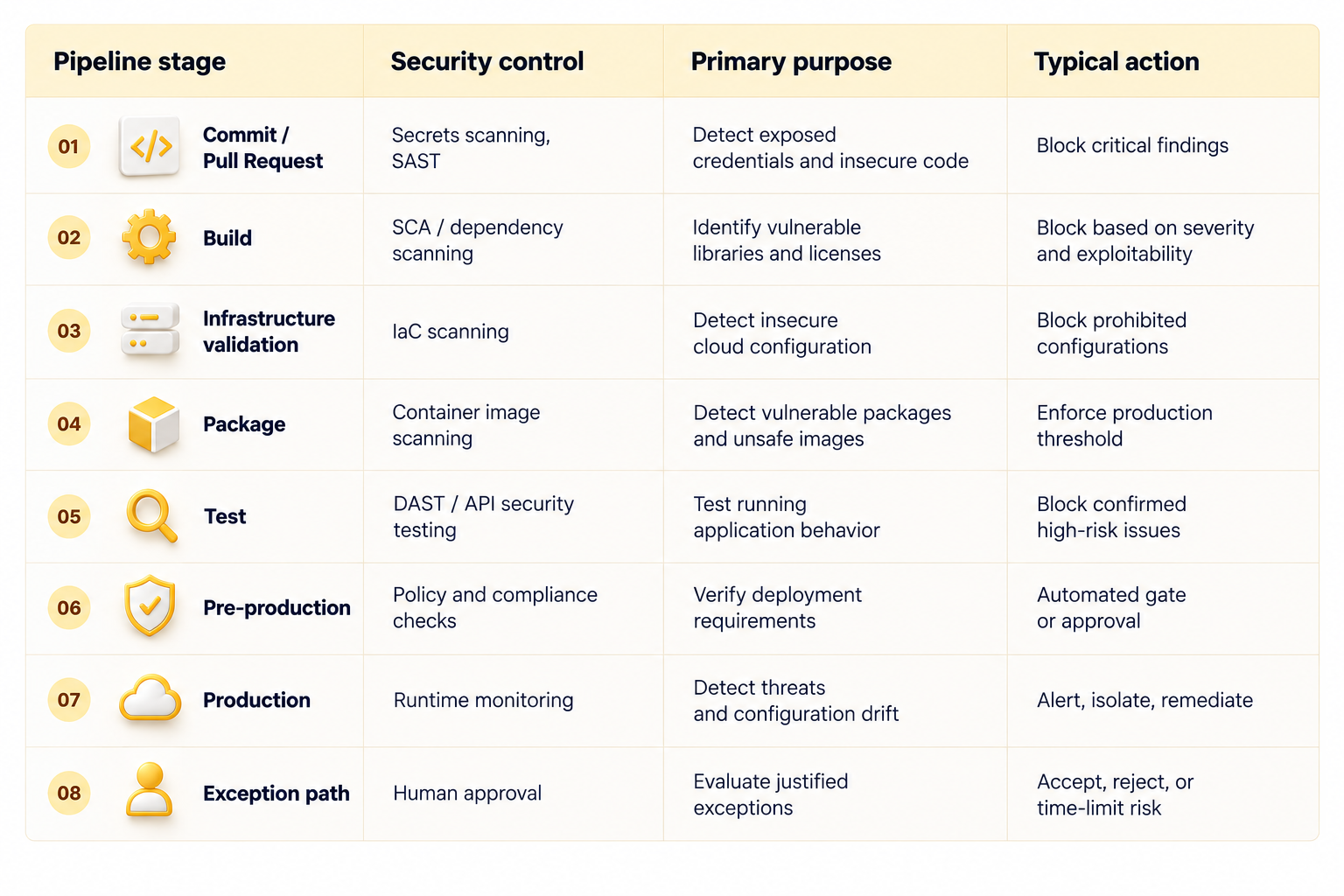
The important part is not the exact tool at each stage. It is the policy behind it. Scanner without an enforcement decision is just another dashboard.
Static Application Security Testing analyzes source code or compiled artifacts without executing the application. It is one of the earliest controls that can be integrated into a CI/CD workflow. But SAST can become noisy. If hundreds of low-confidence findings appear on every pull request, developers quickly learn to ignore them. A better DevSecOps integration starts with a defined threshold. New critical vulnerability in authentication logic may stop a merge. A medium-severity issue in non-sensitive code might create a ticket with a remediation SLA instead. The policy should consider severity, confidence, whether the finding is new or pre-existing, application exposure, and whether the affected component processes sensitive data.
“The question isn’t whether SAST found something. It’s whether the finding is risky enough to stop the change.”
Modern applications contain large dependency trees. Software Composition Analysis helps identify known vulnerabilities and other risks in third-party packages. Simplistic policy such as “block every dependency with a critical CVE” sounds safe but can produce poor engineering decisions. A vulnerability may exist in a package without being reachable by the application. Another vulnerability with a lower severity score may affect an internet-facing component and represent a much more immediate risk.
SCA policy therefore needs context. For production workloads, teams should evaluate vulnerability severity together with exploitability, package usage, exposure, available fixes, and the importance of the affected workload. Dependency scanning should also happen continuously, not only when an application is built. A dependency considered safe when deployed can receive a new vulnerability disclosure weeks later. That makes DevSecOps automation part of operations as well as delivery.
Secrets are different. API keys, private keys, cloud credentials, database passwords, and tokens should not enter source control in the first place. Secrets scanning should therefore run as early as possible, ideally both before code reaches the central repository and again within CI.
When a verified credential is detected, the safest default is generally to stop the change rather than create a warning for later. Removing the string from the next commit is also insufficient if the credential has already been exposed. The response should include revocation or rotation and verification that the secret has not remained accessible through repository history, logs, build artifacts, or other systems.
For organizations where credentials are still stored manually across repositories and CI/CD systems, OpsWorks provides Security & Compliance services that include secrets management implementation alongside DevSecOps integration and security testing automation.
Infrastructure as Code changes the security boundary of the pipeline. Terraform, CloudFormation, Kubernetes, or similar configuration can create an internet-facing service, change an IAM policy, disable encryption, expose storage, or modify network access. Code review alone may not reliably identify every infrastructure risk.
IaC security scanning should evaluate configuration before apply or deployment. This is particularly important for cloud environments because the same reusable infrastructure that improves delivery speed can reproduce a security mistake across multiple accounts, clusters, or environments.
Practical policy might block a public storage bucket, unrestricted administrative access, disabled encryption on sensitive resources, privileged containers, or IAM policies that violate established organizational rules. Less severe configuration improvements can remain warnings.
The broader objective is to turn approved infrastructure patterns into reusable controls. OpsWorks' DevOps Transformation services include Infrastructure as Code implementation alongside CI/CD and toolchain integration, allowing infrastructure automation and security policy to be designed as parts of the same delivery system.
Container security scanning is most useful when it happens at two different points. The first gate evaluates the image before it reaches a production registry or environment. It can detect vulnerable operating-system packages, application dependencies, malware, unsafe configuration, or other image-level risks.
The second control continues after deployment. Image that passed yesterday can become vulnerable tomorrow when a new CVE is published. Production environments therefore need visibility into currently deployed images, not only images moving through the pipeline.
For Kubernetes environments, security also extends beyond image scanning. Admission policies, workload identity, RBAC, network policies, secrets handling, pod security settings, and runtime behavior determine whether a theoretically secure image results in a secure workload. This is where the best DevSecOps practices for cloud environments extend beyond CI/CD itself.
This is one of the most important DevSecOps implementation decisions. If security never blocks delivery, the organization has visibility but weak enforcement. If every security tool can independently stop delivery, the pipeline can become unreliable and developers may search for ways around it. Risk-based model is more practical.
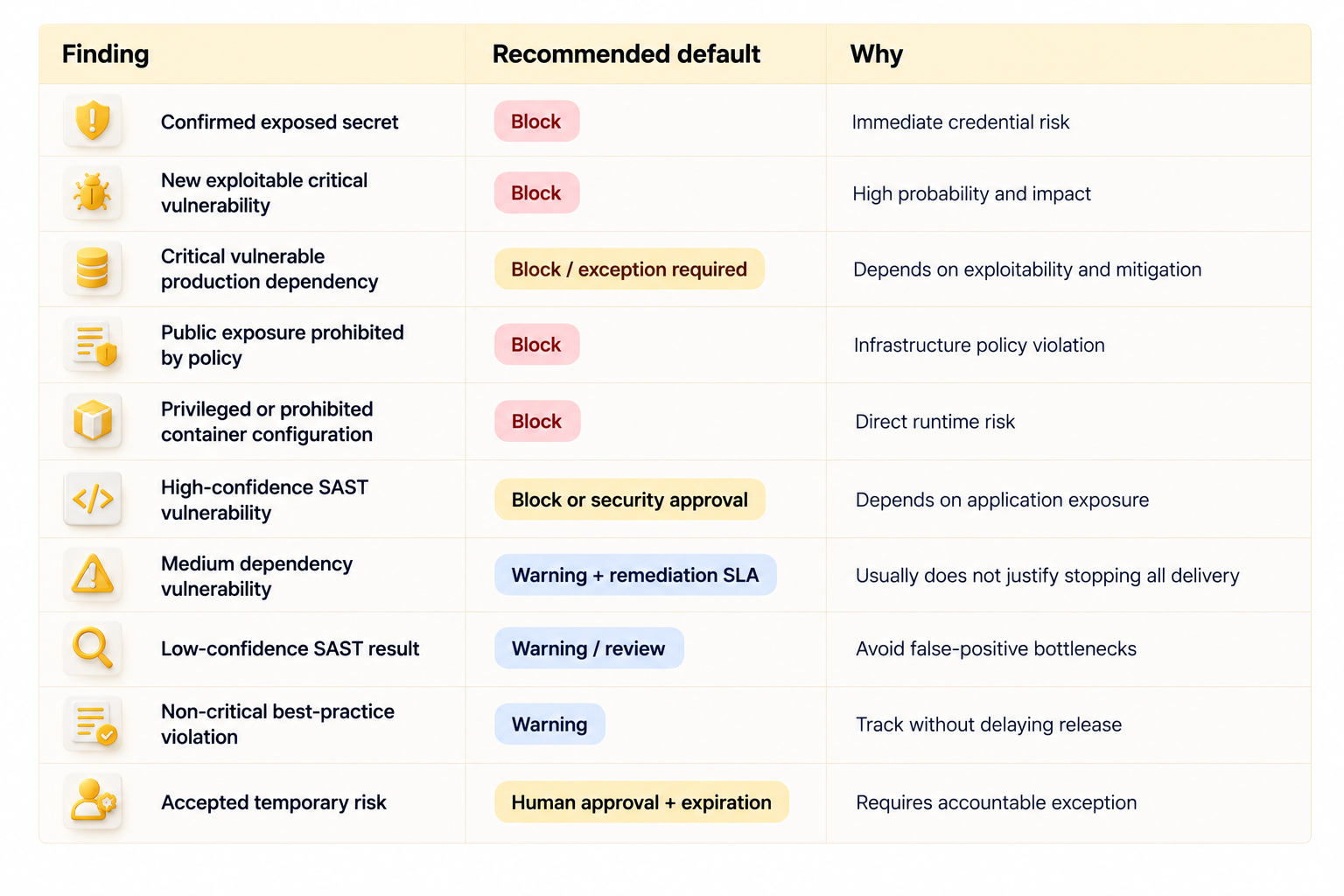
The exact thresholds will differ between organizations. A healthcare application processing protected health information should not necessarily use the same enforcement model as an internal development utility. This is why copying another company's DevSecOps checklist rarely works. The control needs to match the risk.
A useful decision framework is to evaluate every security finding across three dimensions:
High-confidence findings deserve stronger enforcement than noisy heuristic findings.
Vulnerability reachable from an internet-facing API is different from vulnerable code that cannot be reached in the deployed configuration.
Production systems containing financial, healthcare, identity, or other sensitive data require different risk tolerance from temporary development environments. This creates three possible outcomes: automatically block the change, allow it but require remediation, or allow an explicit exception with accountable human approval. The objective is consistent decision-making rather than eliminating every theoretical risk before every deployment.
DevSecOps automation tools are most valuable when the decision can be expressed consistently.
Good candidates for automation include:
That is one of the reasons tool selection should come after policy design. Organizations sometimes start by purchasing several DevSecOps security tools and then attempt to decide how they fit together. The result can be duplicated scans, conflicting severity models, slow pipelines, and multiple dashboards without a clear owner. Start with the control you need. Then select the DevSecOps pipeline tools capable of enforcing it.
Automation should not remove humans from decisions that genuinely require judgment. Human approval remains useful when a team requests a temporary security exception, a critical production change carries unusual operational risk, a vulnerability cannot immediately be patched, a new architecture changes the threat model, or regulatory requirements demand accountable approval.
The important distinction is between approval and routine clicking. If every deployment requires someone to press “Approve” even when there is nothing meaningful to evaluate, that is not governance. It is latency. Human gates should therefore receive enough evidence to make an actual decision: what failed, why the change is needed, the affected system, compensating controls, the owner accepting the risk, and when the exception expires.
DevSecOps architecture should connect security controls to the existing delivery model rather than creating a parallel security pipeline. In a cloud-native environment, security controls should be applied progressively throughout the delivery process. Pull requests can be checked with SAST and secrets scanning before code is merged. During the build stage, SCA can identify vulnerable dependencies, while IaC scanning validates infrastructure configurations. Container images should be scanned before deployment, followed by DAST in a test environment. Policy gates can then determine whether the release is ready for production, while runtime monitoring continues after deployment.
The architecture should also maintain traceability between the source commit, build, artifact, scan results, approvals, deployment, and production version.
This becomes especially important in regulated environments. OpsWorks' Security & Compliance practice supports ISO 27001, SOC 2, PCI DSS, HIPAA, GDPR, CIS Benchmarks, OWASP, and related requirements, alongside compliance audit preparation and security testing automation.
Security controls can also become standardized platform capabilities rather than something every application team assembles independently. The OpsWorks guide to Internal Developer Platforms explains how golden paths can combine CI/CD, Infrastructure as Code, secrets, access policies, and security guardrails into reusable developer workflows.
There is no universal DevSecOps tool stack. One organization may already have GitHub or GitLab security capabilities, a cloud-native secrets manager, Terraform scanning, container registry scanning, and SIEM tooling. Another may require dedicated SAST, SCA, DAST, policy-as-code, and runtime security products.
The decision should be architectural rather than vendor-driven.
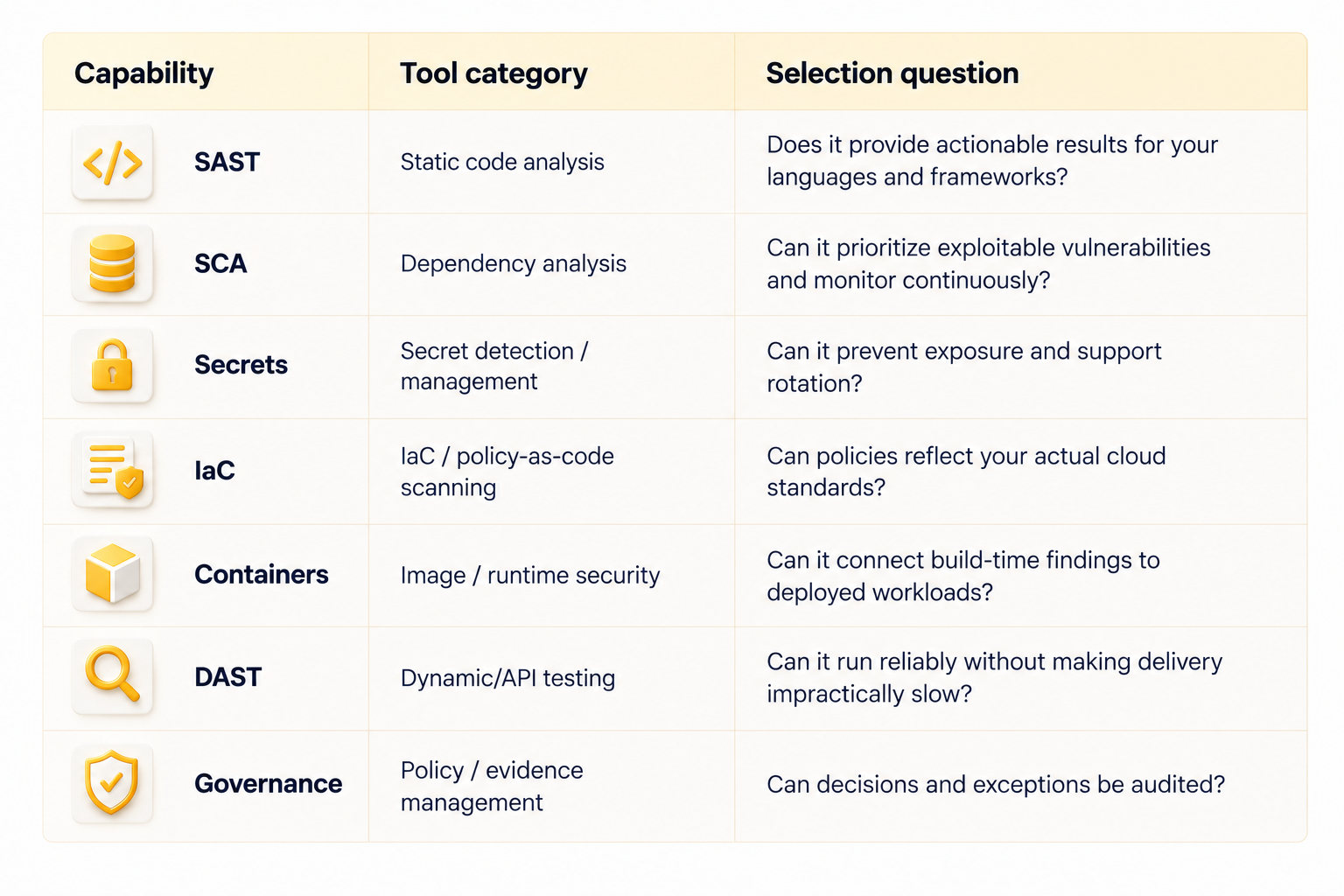
Tool consolidation can be useful, but fewer tools are not automatically better either. The goal is a coherent control plane with clear ownership, usable developer feedback, and predictable enforcement.
DevSecOps implementation should start with the existing delivery path, not a security product shortlist.
First, map one real change from commit to production. Identify where code, dependencies, infrastructure, artifacts, credentials, and approvals enter the flow.
Second, classify the risks that actually matter to the business. Define which conditions are unacceptable, which require remediation, and which can be accepted temporarily.
Third, introduce controls progressively. Start with high-confidence checks that provide fast feedback, then add deeper testing and production controls without making every commit wait for the slowest security test.
Fourth, define ownership. Developers need actionable feedback. Security needs policy ownership and visibility. Platform or DevOps teams need reliable integrations. Business owners need an explicit process for accepting exceptional risk. Finally, measure whether the implementation works.
Useful indicators include pipeline security failure rate, false-positive rate, mean time to remediate vulnerabilities, percentage of applications covered by required controls, security exception volume, secret exposure rate, and the additional pipeline time introduced by security checks. The best DevSecOps implementation improves security without making delivery unpredictable.
Before treating a CI/CD pipeline as production-ready, check whether:
If several of these depend on manual knowledge or vary significantly between teams, the organization probably has security tooling but not yet a consistent DevSecOps operating model.
Small engineering organization with a simple application and established security expertise may be able to implement these controls internally. DevSecOps consulting services become more valuable when the environment includes multiple development teams, several CI/CD implementations, AWS or Azure infrastructure at scale, Kubernetes, strict compliance requirements, legacy applications, or security tooling that generates findings without clear enforcement.
The challenge in those environments is rarely installing another scanner. It is designing how code security, infrastructure security, cloud controls, CI/CD, compliance, developer workflows, and operational monitoring work together.
OpsWorks approaches DevSecOps and Security & Compliance from that systems perspective. Its services include DevSecOps strategies integration, security testing automation, secrets management implementation, cloud security assessment, compliance audit preparation, and incident management, monitoring, and alerting.
For organizations where the delivery process itself needs redesign, these capabilities can be combined with CI/CD implementation and DevOps toolchain integration rather than treating security as a separate layer added afterward.
The goal of DevSecOps is not to make every developer a security specialist. It is to make the secure path easier to follow than the insecure one. Mature pipeline catches high-confidence problems early, automatically enforces controls that should not be negotiable, gives developers useful feedback, keeps slower tests away from unnecessary stages, and reserves human approval for decisions where context genuinely matters.
That is the difference between adding security tools to CI/CD and actually implementing DevSecOps. If security reviews are still delaying releases, pipelines produce more findings than teams can act on, or every engineering team has built its own security workflow, the next step is not necessarily another tool. It is to redesign the controls around the way software actually reaches production.
OpsWorks can assess the existing delivery pipeline, identify security and automation gaps, and design a DevSecOps implementation that integrates security controls without turning them into another delivery bottleneck.


Subscribe to our newsletter and get the latest insights that help you stay ahead of the curve.

© 2017-2025 All rights are reserved


