



Kubernetes makes infrastructure easier to scale. It can also make cloud waste easier to scale. Clusters add nodes, pods request more resources than they consume, idle capacity remains available “just in case,” observability generates more telemetry, and teams struggle to connect AWS spend with individual applications or business units.
Cutting capacity blindly is not the answer. Kubernetes cost optimization works when teams understand which resources workloads actually need, remove waste dynamically, and preserve enough headroom to keep production reliable.
This guide explains how to reduce AWS EKS costs through rightsizing, autoscaling, Spot capacity, smarter purchasing, cost monitoring, and architecture decisions without trading infrastructure savings for instability.
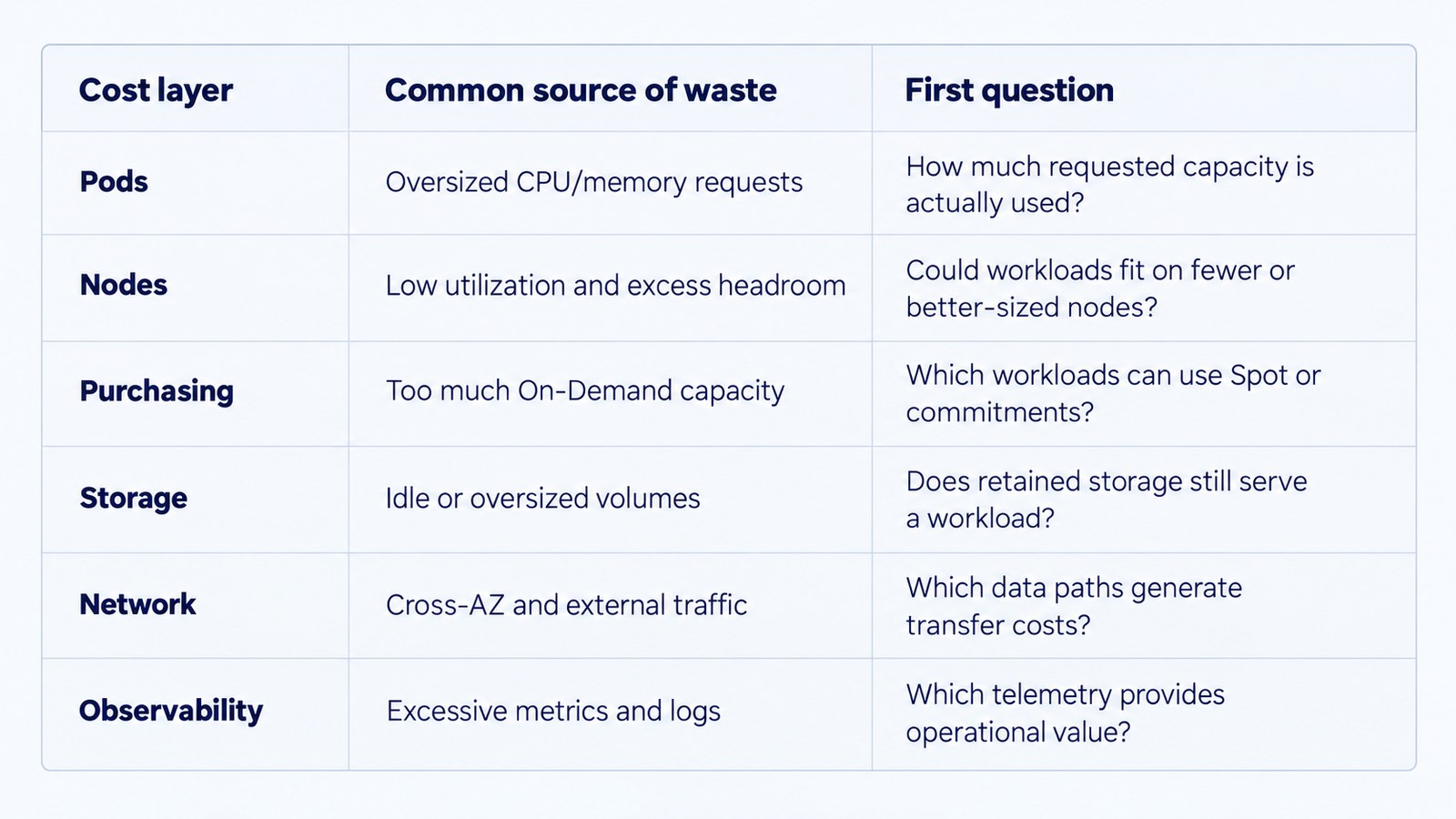
AWS EKS cost is rarely caused by one expensive component. Waste usually accumulates across several layers at once: worker nodes are oversized, pod requests exceed actual consumption, minimum replica counts are too high, development clusters run continuously, persistent volumes are forgotten, traffic crosses Availability Zones unnecessarily, and telemetry retention keeps growing.
AWS recommends treating EKS cost optimization as a combination of cost-effective resources, expenditure awareness, and continuous rightsizing rather than a one-time infrastructure reduction exercise.
Problem becomes harder at enterprise scale because engineering teams see Kubernetes resources while finance teams see AWS services. Neither view explains the whole bill. Useful Kubernetes cost management connects them.
OpsWorks' broader Cloud Cost Optimization guide covers FinOps and cloud-wide optimization. EKS requires another layer because Kubernetes scheduling decisions determine how efficiently AWS capacity is consumed.
Node optimization begins with pods. Kubernetes schedules workloads based largely on resource requests, not average real-world consumption. Oversized requests therefore create artificial demand.
Cluster may appear full even when actual CPU or memory usage is low. Consider a service using 300 millicores of CPU under normal load but requesting 1 CPU per replica. Ten replicas reserve substantially more schedulable capacity than they use. Node autoscaling then reacts to requested resources and keeps more EC2 capacity running.
Reducing requests can improve bin packing immediately. Reducing them without data can also create throttling, memory pressure, or instability.
Effective rightsizing compares:
AWS recommends combining workload metrics with HPA, VPA, and node-level autoscaling. VPA can also be used initially in recommendation mode so teams can evaluate suggested resource changes before applying them to production.
Cost optimization should therefore follow observed behavior rather than static ratios. OpsWorks' Cloud Observability Strategy explains why infrastructure metrics become more useful when correlated with workload and service context.
Rightsizing worker nodes before fixing pod requests often produces temporary improvements. Scheduler still sees inflated demand, so wasted capacity returns. Once workload requirements are realistic, teams can focus on node utilization.
Goal is not to achieve 100% utilization. Goal is to maintain enough capacity for resilience and scaling while reducing infrastructure that provides little operational value.
Both Karpenter and Cluster Autoscaler can adjust EKS compute capacity as workloads change. AWS describes Karpenter as a node lifecycle management system that evaluates pending pod requirements and provisions capacity that can satisfy them. Karpenter can also remove unnecessary nodes and support consolidation.
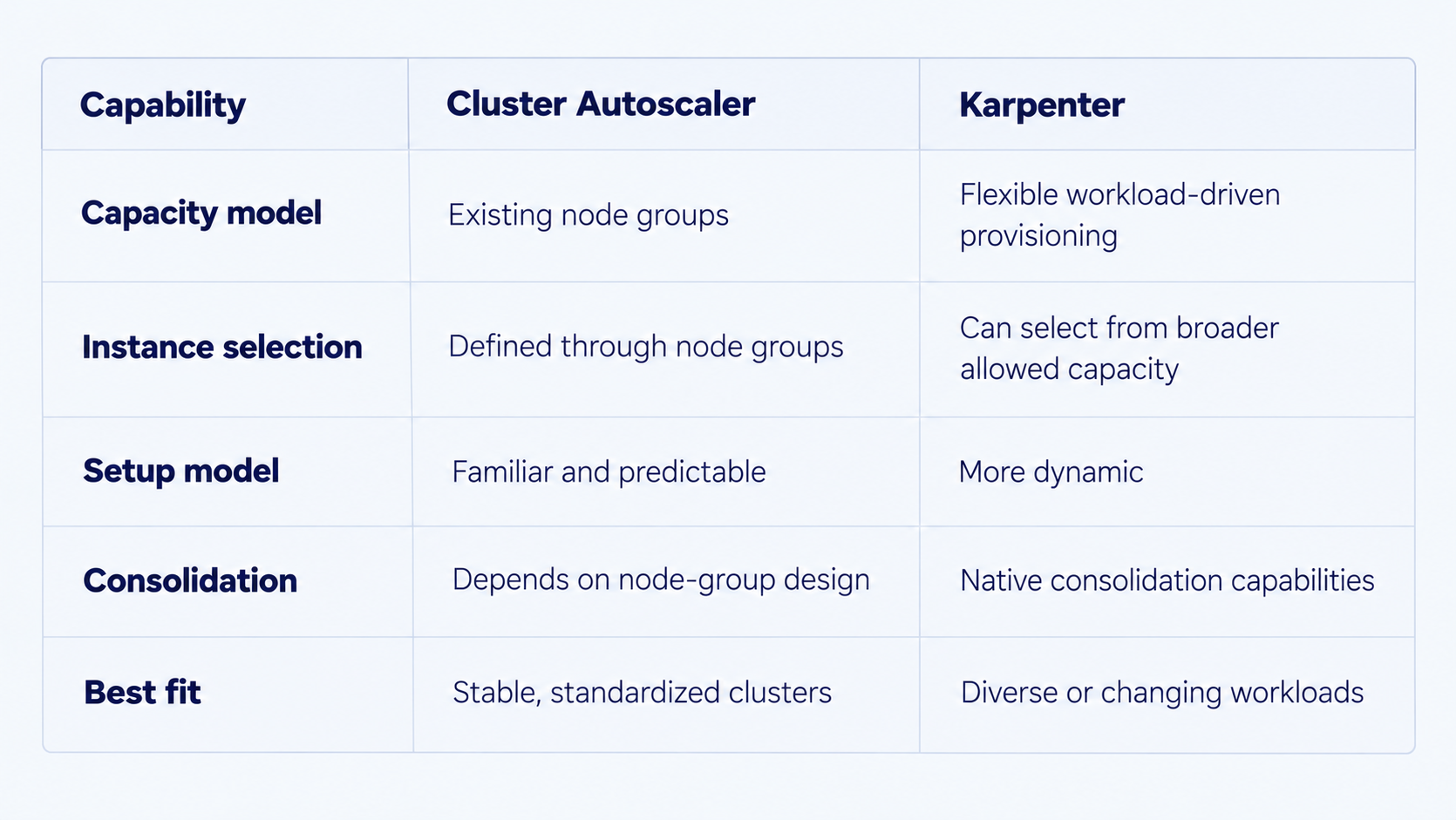
Choice should reflect operating model rather than trend. Stable enterprise environments with predictable node groups may work perfectly well with Cluster Autoscaler. Dynamic platforms with many workload profiles can gain more flexibility from Karpenter.
Kubernetes cost reduction often rewards higher density. Fewer nodes mean less unused compute. Higher density also means less spare capacity.
Aggressive bin packing can increase the time required to place new replicas during traffic spikes because additional infrastructure may need to launch first. AWS explicitly notes this trade-off between bin packing, availability, performance, and cost.
Production strategy should therefore define how much headroom is intentional.
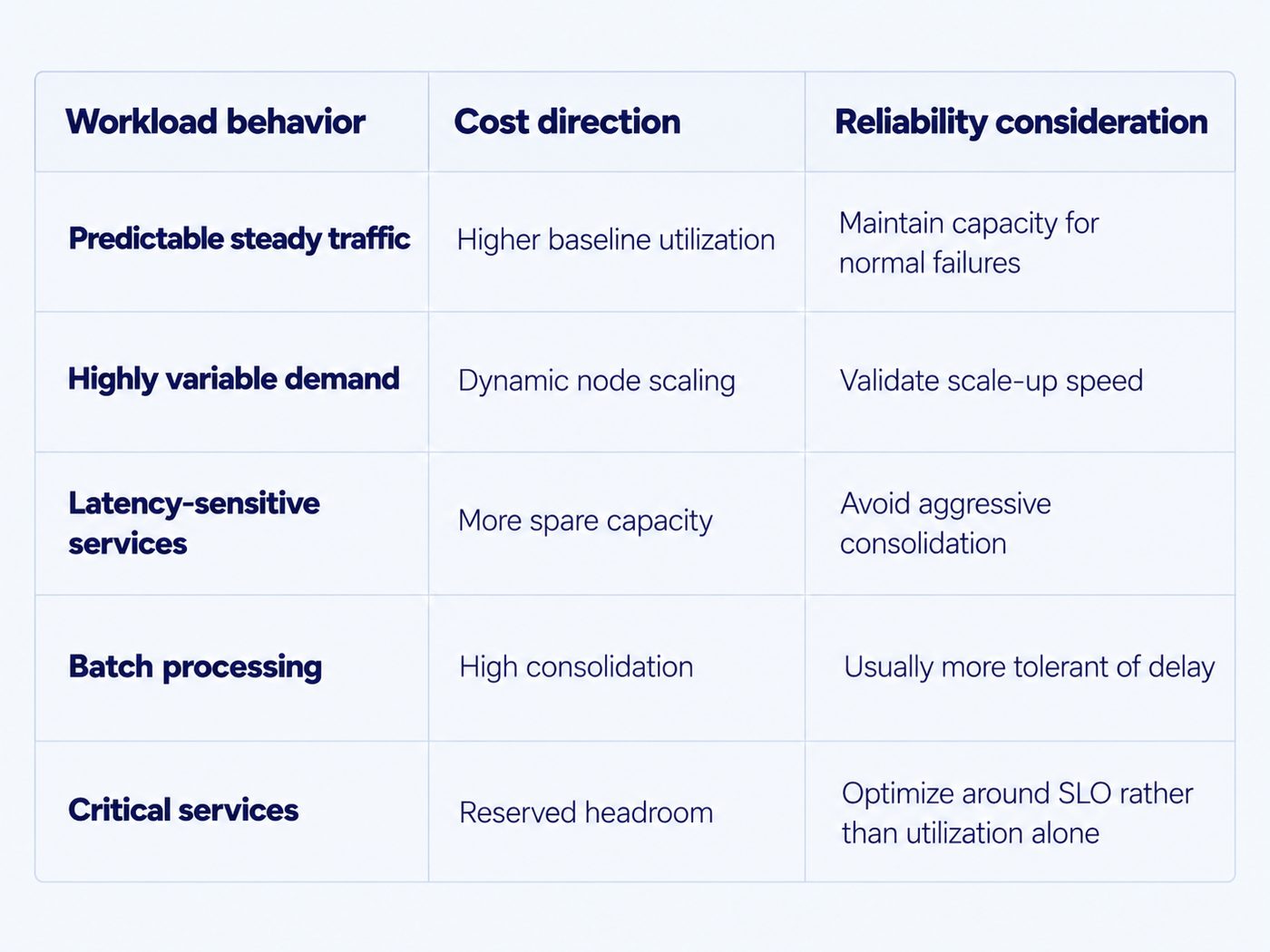
Cost efficiency should never be measured without service reliability.
Spot Instances can materially reduce compute cost, but price is only one part of the decision.
Workload must tolerate interruption. Good candidates often include stateless services with multiple replicas, resilient batch workloads, asynchronous processing, CI runners, or applications designed to replace interrupted capacity quickly.
Poor candidates include workloads that cannot restart cleanly, singleton components, or processes where interruption causes unacceptable business impact. AWS recommends evaluating On-Demand, Spot, and commitment-based purchasing options as part of EKS cost optimization.
OpsWorks encountered this directly in its work with Syndigo. Workload logic was redesigned so processing could tolerate interruptions and scale dynamically, making broader use of Spot practical. Infrastructure spend fell from approximately $1M per month to $80K per month.
Lesson is important: biggest savings may come from changing workload behavior before changing infrastructure pricing.
Strong EKS environments usually combine several capacity models rather than choosing only one. Stable baseline workloads can run on predictable capacity. Variable demand can use dynamic On-Demand or Spot resources. Temporary workloads can scale toward zero when possible.
Purchasing decisions should follow workload behavior.
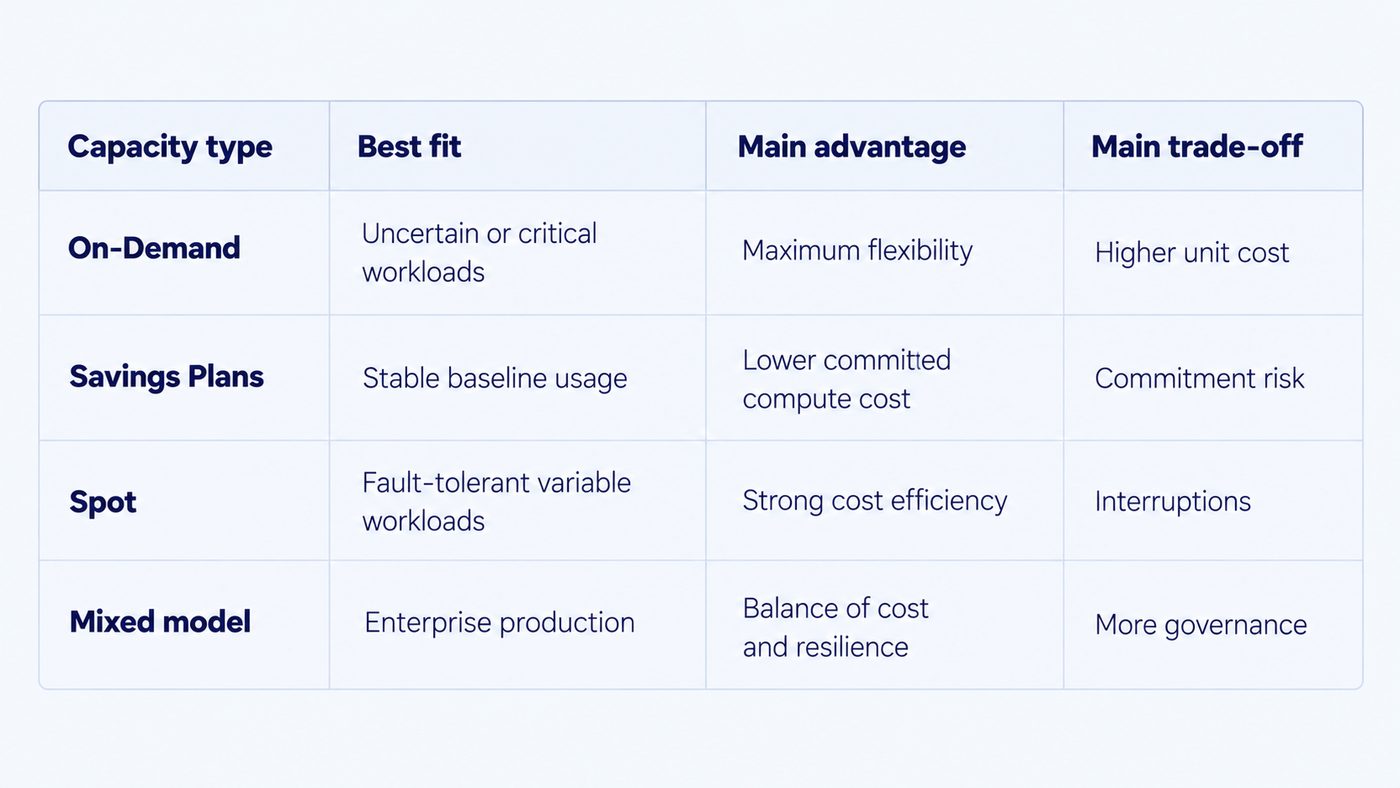
Savings commitment made before rightsizing can lock an organization into paying for capacity it should have removed. Rightsize first. Commit second.
Compute usually receives the most attention, but AWS EKS cost extends beyond worker nodes.
Persistent volumes often survive longer than the workloads that created them. Snapshot retention, overprovisioned volumes, unused persistent storage, and inappropriate storage classes can steadily increase Kubernetes costs. Policies should define ownership, retention, deletion behavior, and expected performance.
Distributed applications can generate significant data-transfer costs. Cross-AZ traffic, NAT gateways, load balancers, external APIs, image pulls, and data movement between services can make a well-utilized cluster unexpectedly expensive. Service placement and network architecture therefore belong in cost analysis.
Metrics, logs, traces, and high-cardinality labels create another scaling curve. Telemetry volume usually grows with infrastructure. Cloud observability should answer operational questions rather than collect every possible signal. Retention tiers, sampling, aggregation, and cardinality controls help prevent monitoring cost from growing faster than the workload itself.
Finance dashboards can show that AWS spending increased. They rarely tell an application owner which Kubernetes deployment caused it. Kubernetes cost monitoring needs allocation. Useful dimensions include namespace, workload, cluster, environment, team, product, and business unit. AWS provides billing and infrastructure visibility through tools such as Cost Explorer and CloudWatch, while Kubernetes-specific tooling can add workload-level allocation.
Kubecost is one option for translating Kubernetes resource usage into cost visibility. Amazon EKS supports an AWS-optimized Kubecost bundle that can break costs down across resources such as pods, nodes, namespaces, and labels. This makes it useful for cost allocation and chargeback or showback models.
Kubecost EKS data becomes most valuable when teams already maintain consistent labels and ownership. Poor metadata creates poor cost attribution. Tool therefore does not replace governance. It exposes whether governance exists.
Lowest possible cluster bill is rarely the right objective. Enterprise platforms should optimize the cost of delivering reliable application capacity.
Reducing a cluster from $100,000 to $70,000 per month is not an improvement if latency doubles or incident frequency increases.
Better metrics connect money with output. Examples include cost per transaction, cost per tenant, cost per request, cost per batch job, or infrastructure cost as a percentage of service revenue.
Such metrics also make Kubernetes cost management easier to discuss with product and finance teams.
Optimization becomes easier when teams start from the symptom rather than immediately selecting a tool.
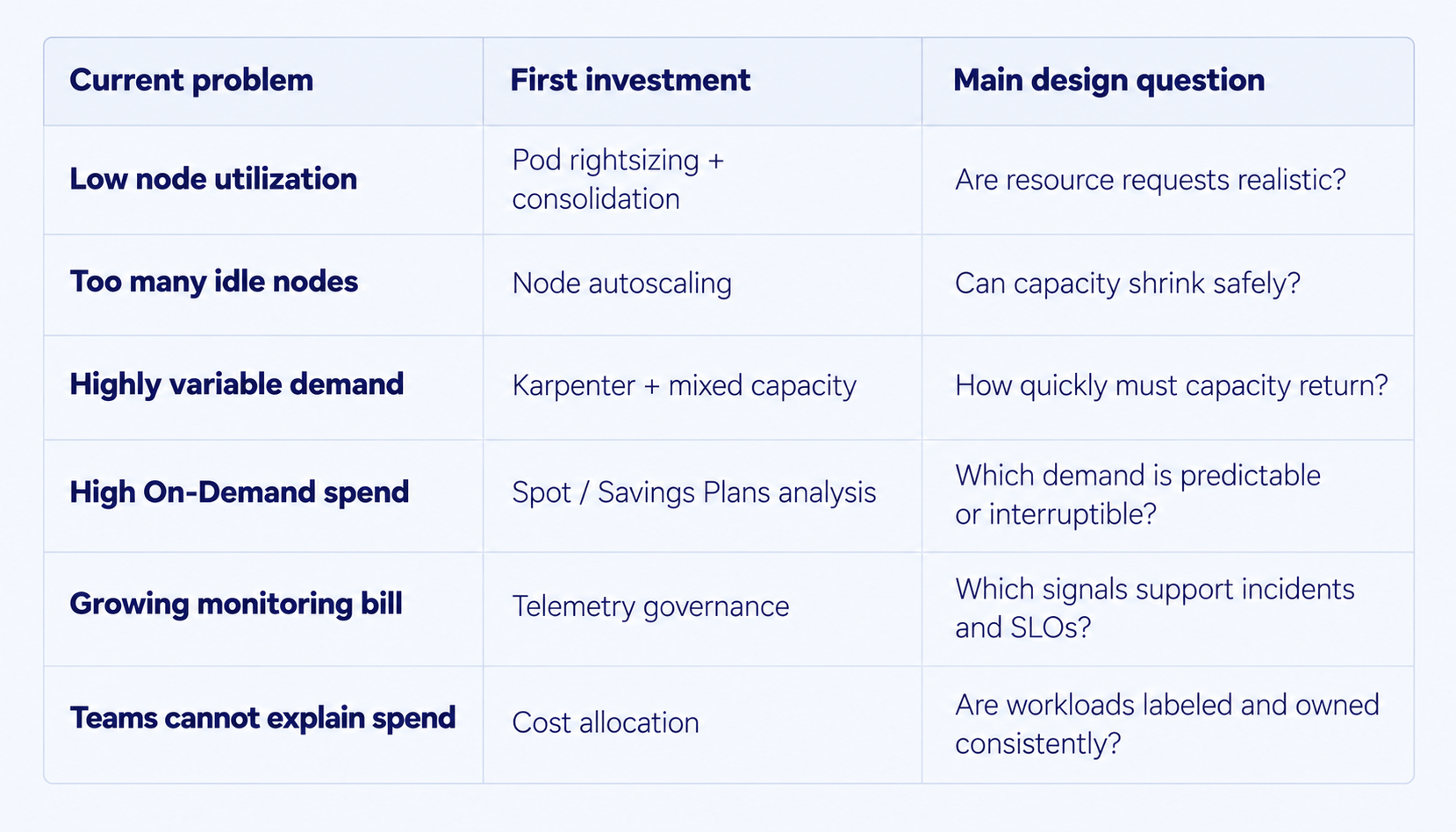
Practical sequence is:
Sequence matters because each layer influences the next.
Cost optimization has a natural boundary. Required SLOs, RTO/RPO, failure domains, replica counts, PodDisruptionBudgets, scaling response, and compliance requirements define capacity that may look “unused” but is intentionally reserved.
AWS Well-Architected Review is useful here because cost optimization is only one architecture pillar. Reliability, performance efficiency, security, and operational excellence influence how aggressively infrastructure can be reduced.
Question should not be:
“How much infrastructure can we remove?”
Better question is:
“How little infrastructure can we run while still meeting the workload’s reliability and performance requirements?”
Complex EKS cost problems rarely come from one Kubernetes setting.
Waste may be rooted in application architecture, resource requests, node groups, scaling logic, AWS purchasing, networking, observability, or deployment patterns.
OpsWorks' Proven Reference AWS EKS Infrastructure combines workload analysis, EKS, Terraform, CI/CD, monitoring, and scalable infrastructure patterns with cost efficiency built into the architecture.
Broader DevOps Transformation engagements can also cover infrastructure assessment, scalability, IaC, orchestration, performance optimization, and monitoring when EKS costs are symptoms of a larger platform problem.
Goal is not simply a smaller AWS bill. Goal is an EKS platform where cost scales predictably with business demand.
Kubernetes cost optimization should become part of normal platform operations. Resource requests change. Traffic changes. New services appear. Engineers introduce new storage and network patterns. Commitments expire. Kubernetes cost therefore drifts unless teams continuously measure it.
Strong operating model connects cost data with deployment, observability, capacity, ownership, and reliability. OpsWorks' GitOps for Cloud Infrastructure approach can support that model by keeping infrastructure decisions version-controlled and repeatable. Cost efficiency then becomes an engineering property rather than a quarterly cleanup project.
Kubernetes cost optimization is the process of reducing unnecessary infrastructure and platform spend while maintaining required performance and reliability. Work usually includes pod rightsizing, better node utilization, autoscaling, purchasing optimization, storage and network controls, and cost allocation.
EKS costs often grow because pods request more resources than they use, nodes remain underutilized, workloads rely too heavily on On-Demand capacity, storage and networking are not actively managed, or monitoring data grows without retention controls.
Start with workload-level utilization and requests. Rightsize pods, improve node consolidation, use Karpenter or Cluster Autoscaler where appropriate, introduce Spot for interruption-tolerant workloads, evaluate Savings Plans for predictable usage, and monitor storage, network, and telemetry costs.
Karpenter can help reduce unused compute by provisioning capacity based on workload scheduling requirements and removing capacity that is no longer needed. Savings depend on workload design, provisioning rules, consolidation settings, and required availability.
Kubecost provides Kubernetes-level cost visibility and allocation. Teams can analyze costs by pods, nodes, namespaces, labels, and other Kubernetes dimensions instead of relying only on AWS service-level billing data.
Yes, when optimization is based on workload data and reliability requirements. Rightsizing, autoscaling, Spot adoption, and consolidation should be tested against SLOs, capacity needs, disruption budgets, and scaling behavior rather than optimized purely for maximum utilization.


Subscribe to our newsletter and get the latest insights that help you stay ahead of the curve.

© 2017-2025 All rights are reserved


