




Production AI rarely becomes expensive because of one bad model choice. Cost usually grows through a stack of small inefficiencies: oversized models, low GPU utilization, long prompts, unbounded context, inefficient batching, poorly matched hardware, and serving frameworks that were never tuned for real traffic.
LLM inference turns those inefficiencies into recurring infrastructure spend. Every extra millisecond of latency, unused gigabyte of memory, and idle accelerator can affect unit economics at scale.
AI model optimization should therefore answer one business question: how can teams deliver the required quality and response time with the least compute necessary?
This guide explains how to reduce inference cost, latency, and GPU usage through model quantization, model pruning, serving optimization, GPU efficiency, and FinOps for AI without treating optimization as a race to the smallest possible model.
Training gets attention because it is visibly expensive. Inference can become the larger long-term cost once a model serves real users continuously.
Request volume compounds inefficiency: larger contexts increase compute pressure, poor batching wastes accelerator capacity, and oversized models consume more infrastructure than the task requires. Result is familiar: adoption grows and spend rises faster than business value.
Useful inference cost analysis should separate four layers:
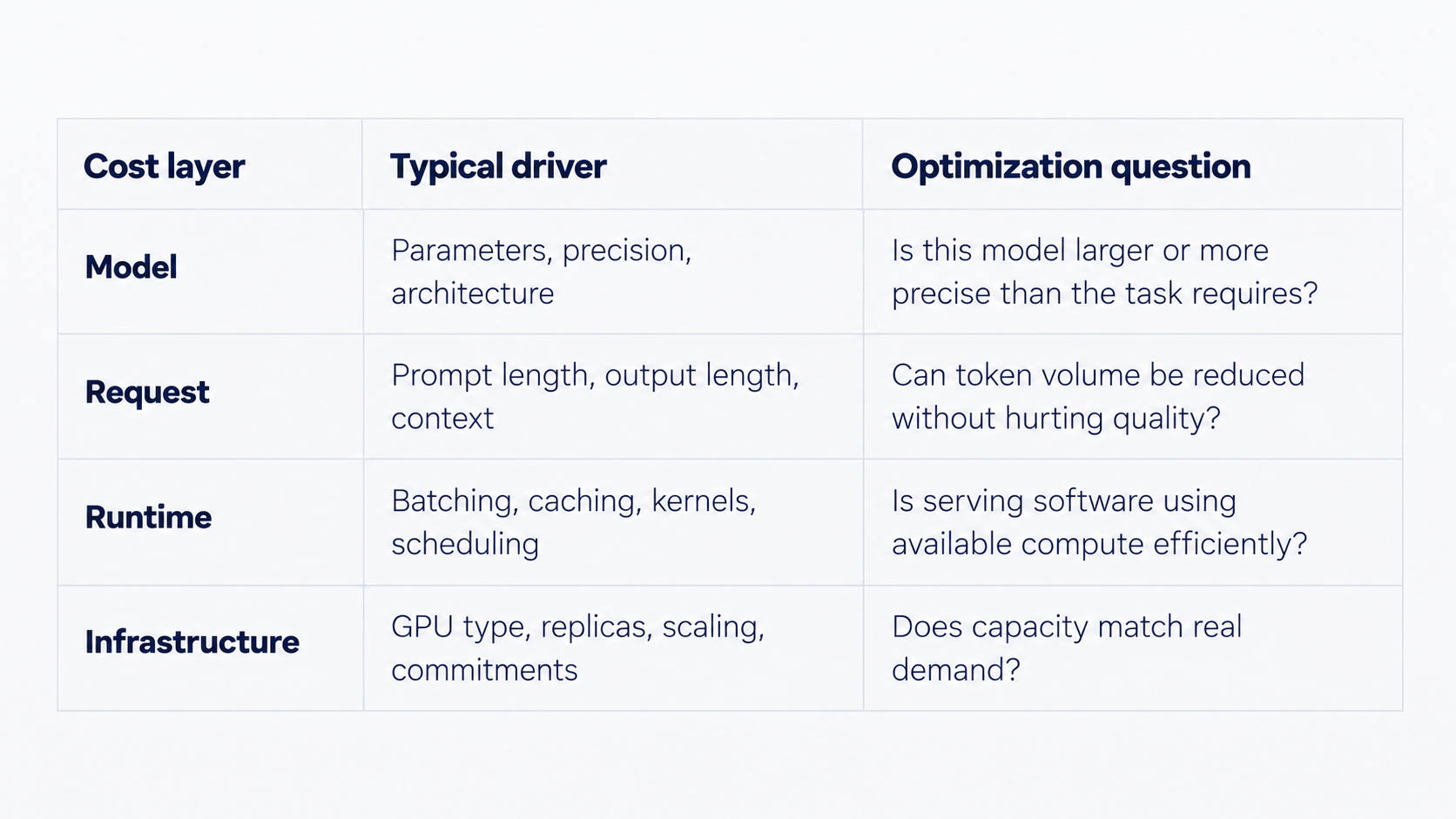
OpsWorks approaches cloud efficiency as an architecture problem rather than a billing-only problem. Same principle applies to AI: cost cannot be optimized without understanding how models, traffic, serving software, and infrastructure interact.
Model optimization without a baseline creates false wins.
Lower GPU usage can look positive while throughput collapses. Faster average latency can hide worse p99 behavior. Lower inference cost can come from a smaller model that materially reduces answer quality.
Production baseline should capture business and technical metrics together:
Cloud observability matters here. GPU metrics explain infrastructure pressure, while application traces and request metadata explain why it happened. OpsWorks' Cloud Observability Strategy shows how to connect infrastructure signals with service context.
Scaling hardware is often the fastest operational response to slow inference. It is also one of the easiest ways to make an inefficient model more expensive.
Model optimization should ask whether the workload needs the current parameter count, numerical precision, and architecture before increasing capacity.
Model quantization lowers the numerical precision used for weights and sometimes activations. Lower precision can reduce memory footprint and compute, allowing more concurrent requests on the same hardware.
PyTorch supports quantization workflows, while TensorRT-LLM and ONNX Runtime provide quantization and runtime optimization options for deployment. NVIDIA describes TensorRT-LLM quantization as a way to reduce memory footprint and computational cost through lower-precision representations such as FP8, FP4 and INT formats.
Useful question is not “Can this model run at INT8 or FP8?” but:
“What precision gives us the best cost and latency improvement while keeping quality within an acceptable tolerance?”
Benchmark quantization on representative prompts, sequence lengths, and production hardware.
Model pruning removes weights or structures that contribute little to output quality. AI model compression can combine pruning, lower precision, distillation, or architecture changes.
Sparse models do not automatically produce proportional latency savings unless runtime and accelerator kernels can exploit that sparsity. Decision should therefore be hardware-aware.
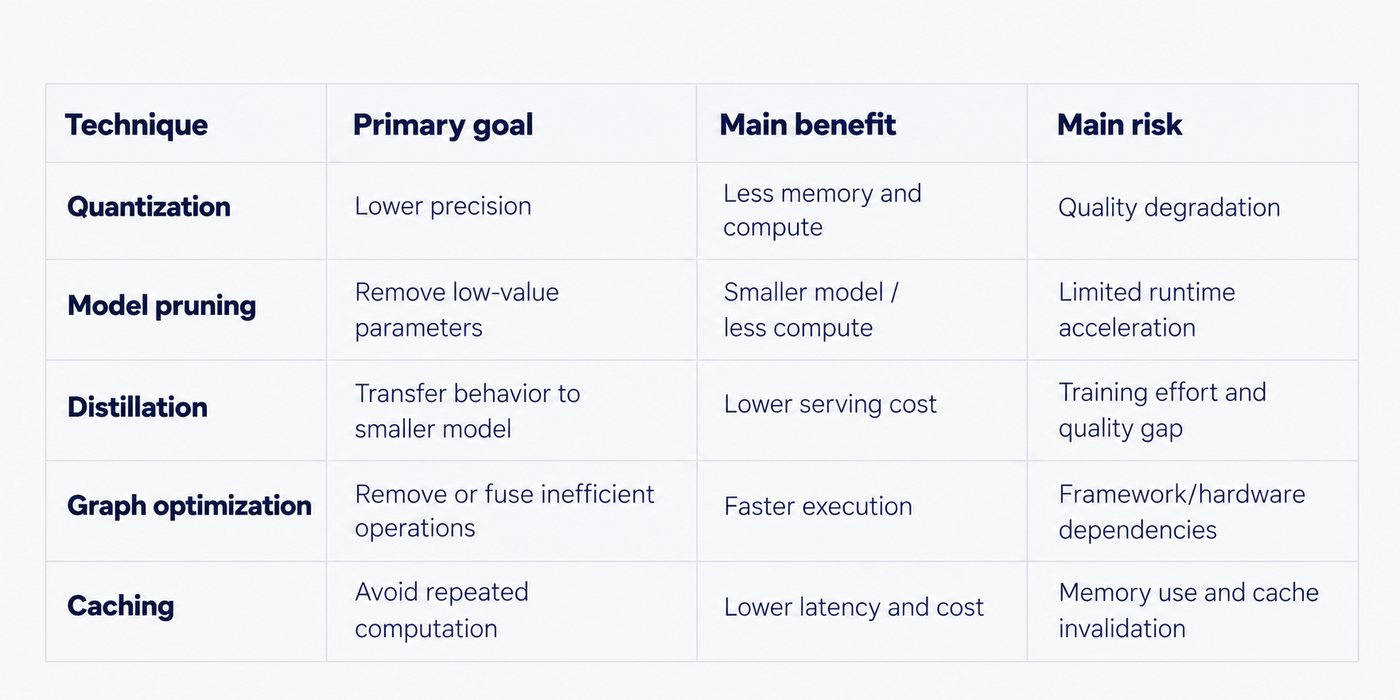
GPU optimization is not the same as buying faster GPUs. Expensive accelerators still deliver poor economics when requests arrive unevenly, batches stay small, or replicas sit idle. Goal is more useful work per GPU while staying inside latency targets.
Static batching can improve throughput but also increase queue time. Continuous or in-flight batching lets a serving runtime add and remove requests as sequences complete, which fits variable LLM generation lengths better.
vLLM supports continuous batching, PagedAttention, prefix caching, distributed inference, and multiple quantization approaches. TensorRT-LLM also provides in-flight batching, KV-cache management and NVIDIA-specific inference optimizations.
Neither framework is universally “faster.” Workload shape determines the winner.
Long contexts can consume large amounts of GPU memory because serving systems must retain key-value state during generation.
Higher memory pressure reduces concurrency and can force extra replicas even when raw GPU compute is not saturated. Context limits, prompt compression, prefix caching, and workload routing therefore become cost controls.
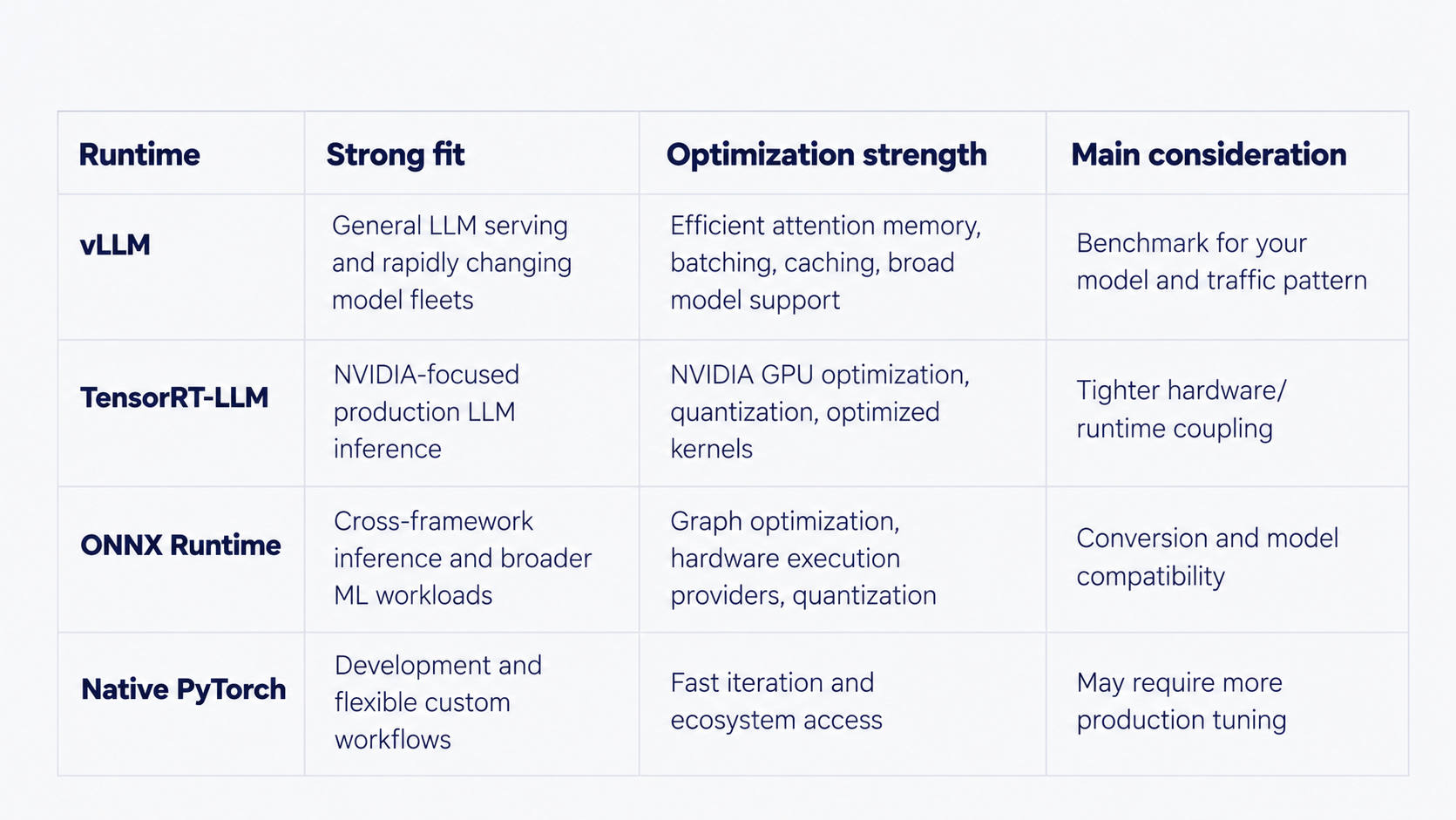
vLLM documents PagedAttention, continuous batching, prefix caching, distributed inference, and multiple quantization formats. TensorRT-LLM focuses heavily on NVIDIA execution and quantization, while ONNX Runtime provides graph and runtime optimization across multiple execution providers.
Selection should be based on measured throughput, latency, memory use, model compatibility, and operational complexity.
Model and GPU tuning receive most attention, but many AI systems waste compute before inference begins. Repeated system prompts, oversized retrieval context, loose output limits, and poor routing all increase cost without changing model weights.
Useful actions include:
For multi-provider architectures, platform choice also affects cost. OpsWorks' AWS Bedrock vs Azure OpenAI vs GCP Vertex AI comparison shows why token pricing alone is not enough.
That distinction matters because managed AI platforms also introduce surrounding costs such as retrieval, guardrails, logging, provisioned throughput, and data transfer.
FinOps for AI should not begin after finance notices a spike. Engineering teams need unit economics that map AI spend to product behavior: cost per workflow, conversation, document, thousand requests, or successful automation.
Raw GPU spend cannot tell whether cost grew because adoption increased or efficiency declined.
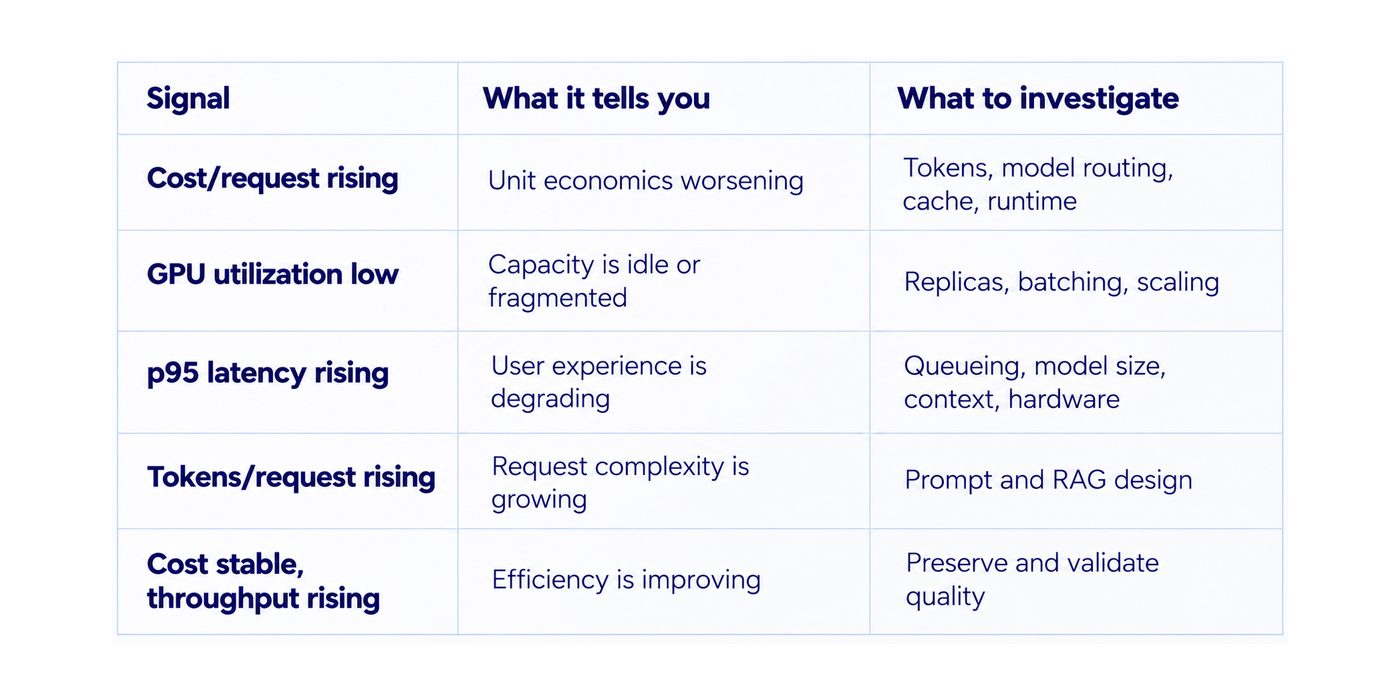
FinOps for AI works best when cost metrics sit beside latency, throughput, and quality metrics rather than in a separate finance dashboard. Broader infrastructure cost principles are covered in OpsWorks' Cloud Cost Optimization guide, including unit economics, continuous optimization, and the limits of tool-only cost management.
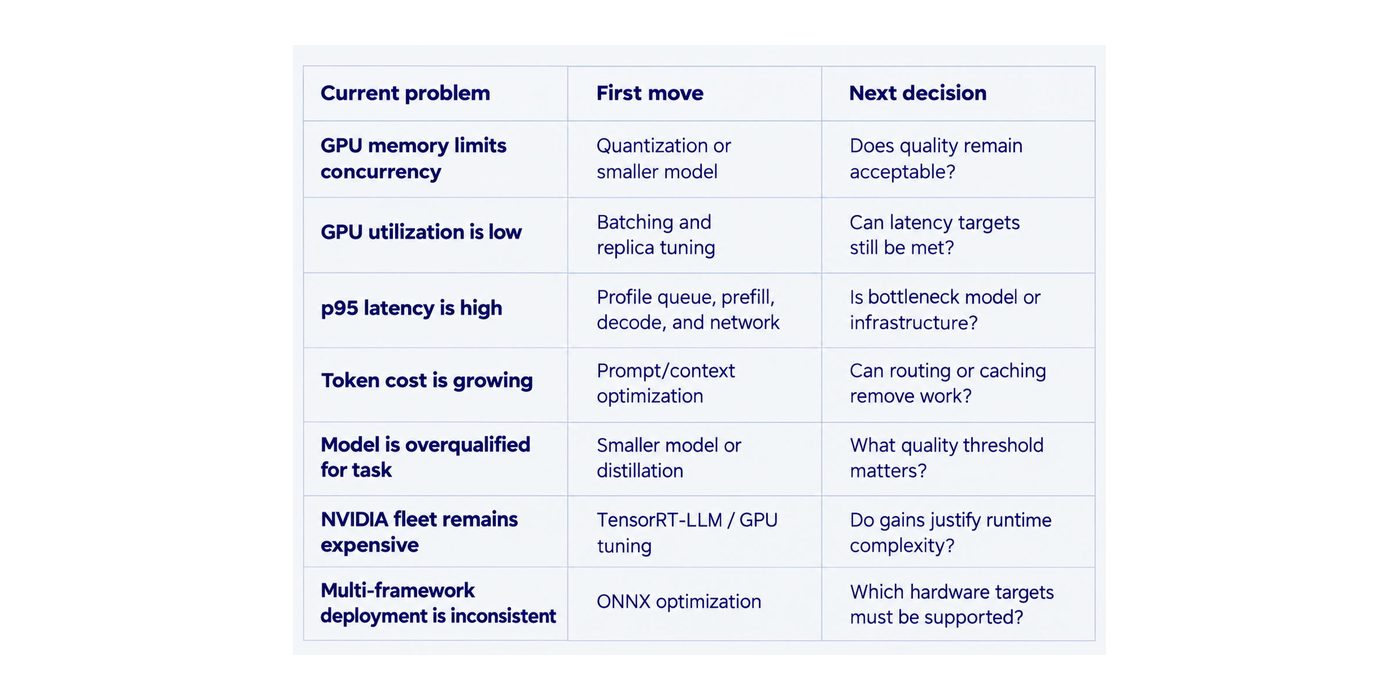
Practical order is simple: profile, remove avoidable request work, optimize model precision or size, tune serving, then resize infrastructure. Buying new GPUs earlier often hides the bottleneck.
Architecture becomes the real problem when teams run multiple model families, traffic is highly variable, or workloads have different latency classes.
Production AI may then require:
OpsWorks' AI/ML Enablement service covers Model Optimization and Performance Tuning, Model Development and Deployment, and AI/ML Infrastructure Setup and Management especially relevant when problems span model, runtime, cloud architecture, and operations. OpsWorks positions this work around reducing latency, improving resource utilization, optimizing AI infrastructure, and supporting production-ready deployment.
Model performance, GPU utilization, latency, reliability, and cost are interconnected. Improving one metric in isolation can move cost somewhere else.
Engagement can begin with workload and architecture assessment, followed by profiling, performance tuning, infrastructure optimization, and ongoing monitoring.
Goal is not maximum compression or maximum GPU utilization. Goal is an AI system that delivers required quality and latency at a cost the business can scale.
Strong AI model optimization reduces wasted computation while preserving what users value. Quantization, pruning, vLLM, TensorRT-LLM, ONNX optimization, caching, batching, and GPU tuning are tools; production economics determine which matter.
Teams that measure cost, latency, quality, and utilization together can make those decisions continuously instead of waiting for the next cloud bill.
AI model optimization is the process of improving model efficiency while preserving required output quality. Work can include model quantization, pruning, compression, graph optimization, serving-runtime tuning, batching, caching, and infrastructure optimization.
LLM inference cost can be reduced by choosing an appropriately sized model, lowering numerical precision, reducing unnecessary tokens, improving batching and caching, increasing GPU utilization, tuning autoscaling, and routing workloads to the right model or hardware.
Quantization can reduce memory usage and computational cost, and it may improve inference latency when hardware and runtime support the selected precision efficiently. Results should be benchmarked because gains depend on model architecture, accelerator, batch size, sequence length, and serving stack.
vLLM focuses on flexible, high-throughput LLM serving with features such as PagedAttention, continuous batching, caching, and broad model support. TensorRT-LLM is optimized closely around NVIDIA hardware and provides NVIDIA-specific kernels, quantization, batching, and execution optimizations.
FinOps for AI applies cost visibility, accountability, and optimization practices to AI workloads. Focus moves beyond total GPU or API spend toward unit economics such as cost per request, workflow, customer interaction, or generated outcome.
Optimization should come first when low utilization, oversized models, unnecessary precision, excessive tokens, inefficient batching, or serving overhead are the main bottlenecks. Additional GPUs make sense when architecture is already efficient and demand genuinely exceeds available capacity.


Subscribe to our newsletter and get the latest insights that help you stay ahead of the curve.

© 2017-2025 All rights are reserved


